
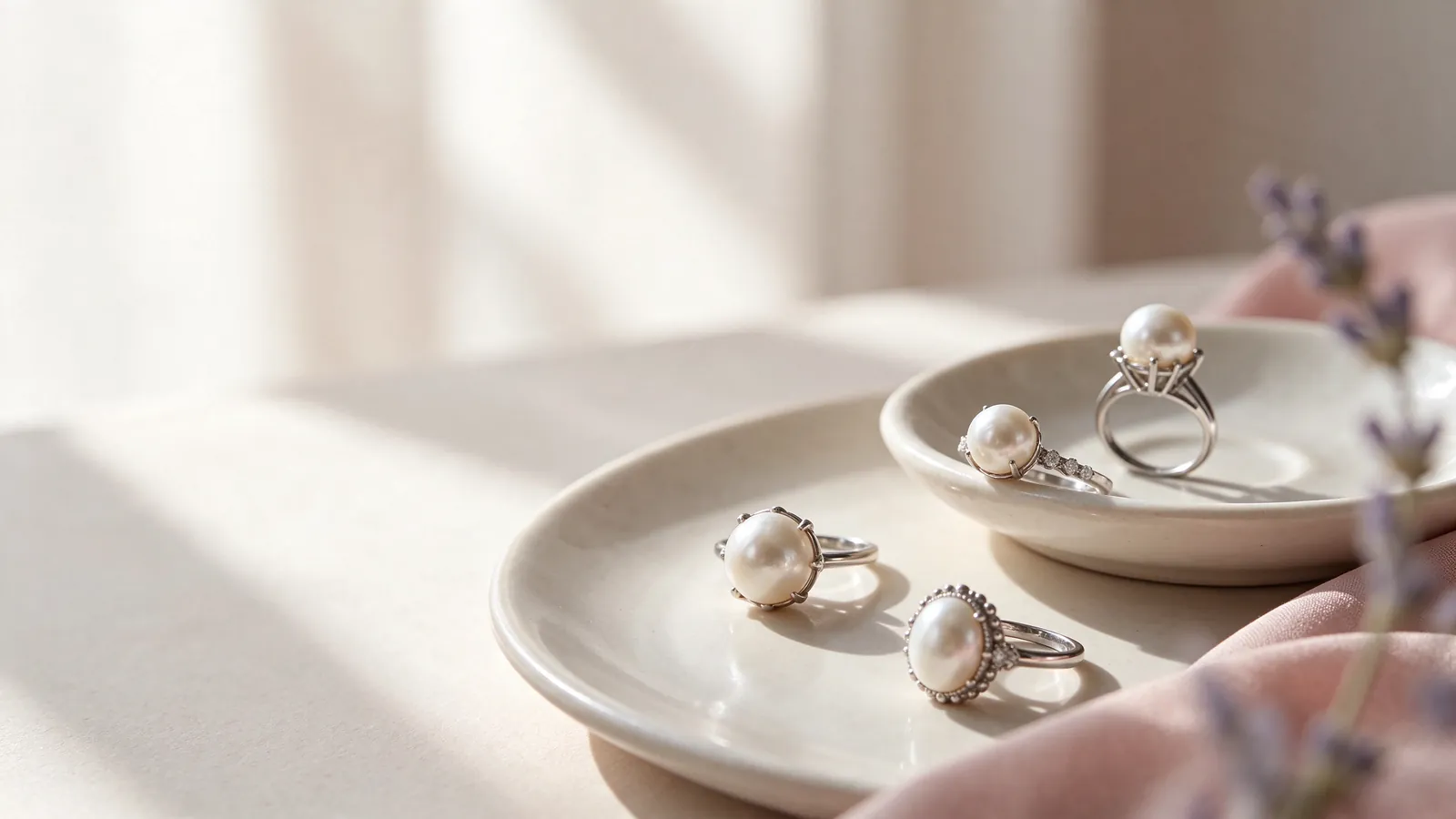
What gives a pearl butterfly ring visual balance, whether it is described as a butterfly pearl ring or an Akoya butterfly ring?
Start by deciding which part of the ring you want to notice first. A pearl centered between wings makes a different impression from a pearl placed beside the butterfly. Neither arrangement is automatically better. With your hand resting normally, check whether you can read both the rounded pearl and the wing outline, or whether one element blocks the detail that made the design appealing.
An enlarged photo can make broad wings seem lighter and more compact than they look on a finger. Compare the face with the width of your hand, then turn it to inspect the profile. Note whether the highest point is a wing, the pearl or its support. Exploring pearl rings more broadly can help you recognize which face proportions you like before focusing on butterfly designs.
When trying on a pearl butterfly ring, how should a butterfly pearl ring or an Akoya butterfly ring sit on your finger?
Allow the ring to find its resting position instead of keeping the motif straight with your opposite hand. Open your fingers and make a loose fist, watching for rotation or sideways pressure from adjacent fingers. If the face keeps tilting even when the band feels appropriate, ask about the relationship between the design's balance and the chosen finger rather than immediately opting for a tighter size.
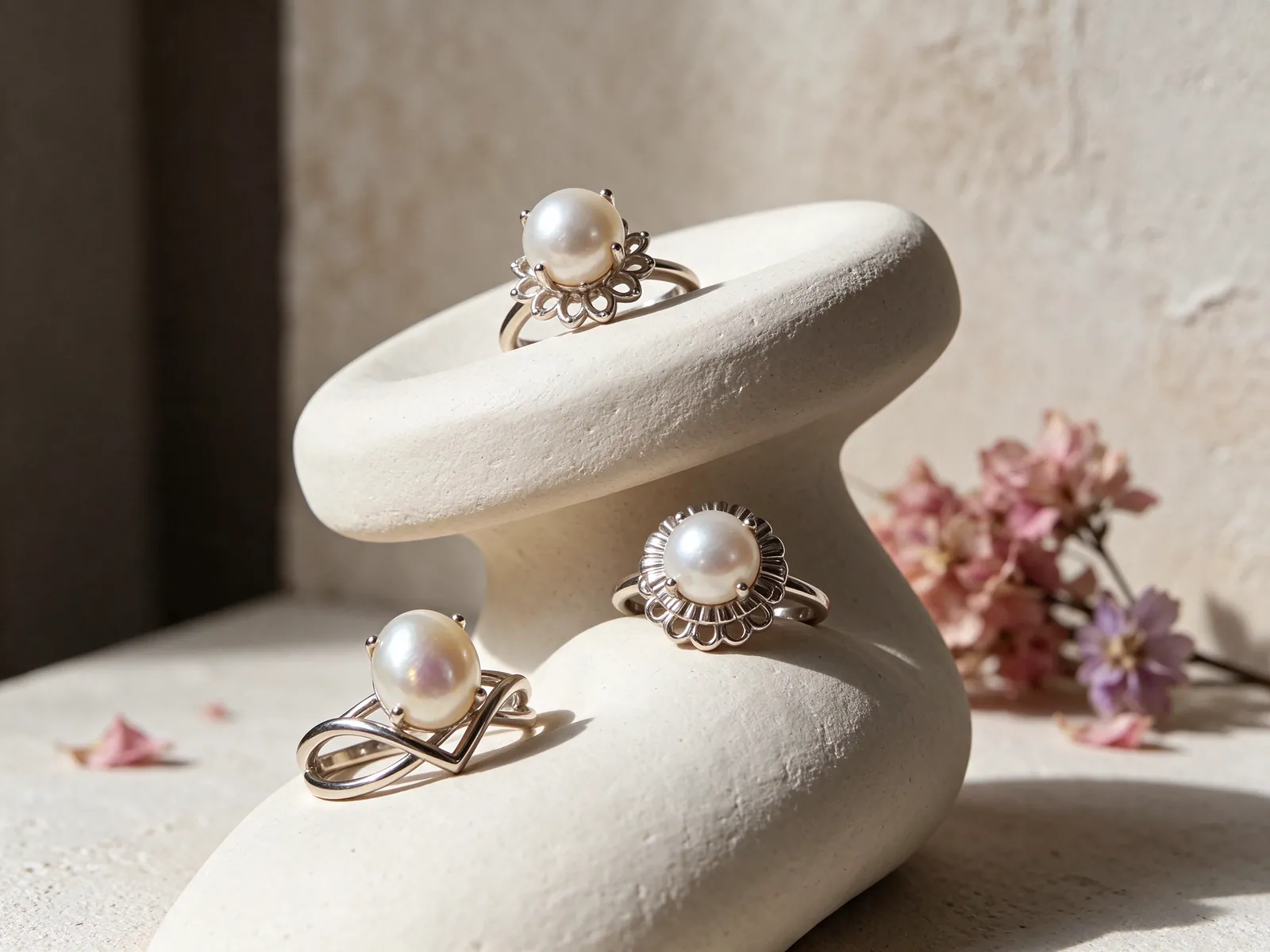
Find the outline you like, not just the motif name
Think about whether you prefer curved wings, a fine open outline or distinctly pointed accents. Curves can echo the pearl's rounded form, while directional wings can make the design feel more graphic. Examine the spaces between the elements as carefully as the metal itself. A visually open face does not prove that the ring weighs less; appearance and physical weight are separate considerations.
Use related motifs to clarify your taste. If you enjoy a design built around a center, compare a pearl flower ring. If a single sweeping curve is what attracts you, consider the design questions in a crescent moon pearl ring. A pearl tiara ring provides a contrast for upward-pointing details. The comparison is about line and layout, not a promise that any symbol offers protection or a particular emotional result.
Compare fingertip-facing and wrist-facing views
Reverse the ring's direction during a try-on and notice how the sequence of pearl and wings changes. Look with your arm resting at your side and while holding a bag or phone. An asymmetrical arrangement may read differently on the other hand, so the direction used in a display image need not determine your own wearing preference.
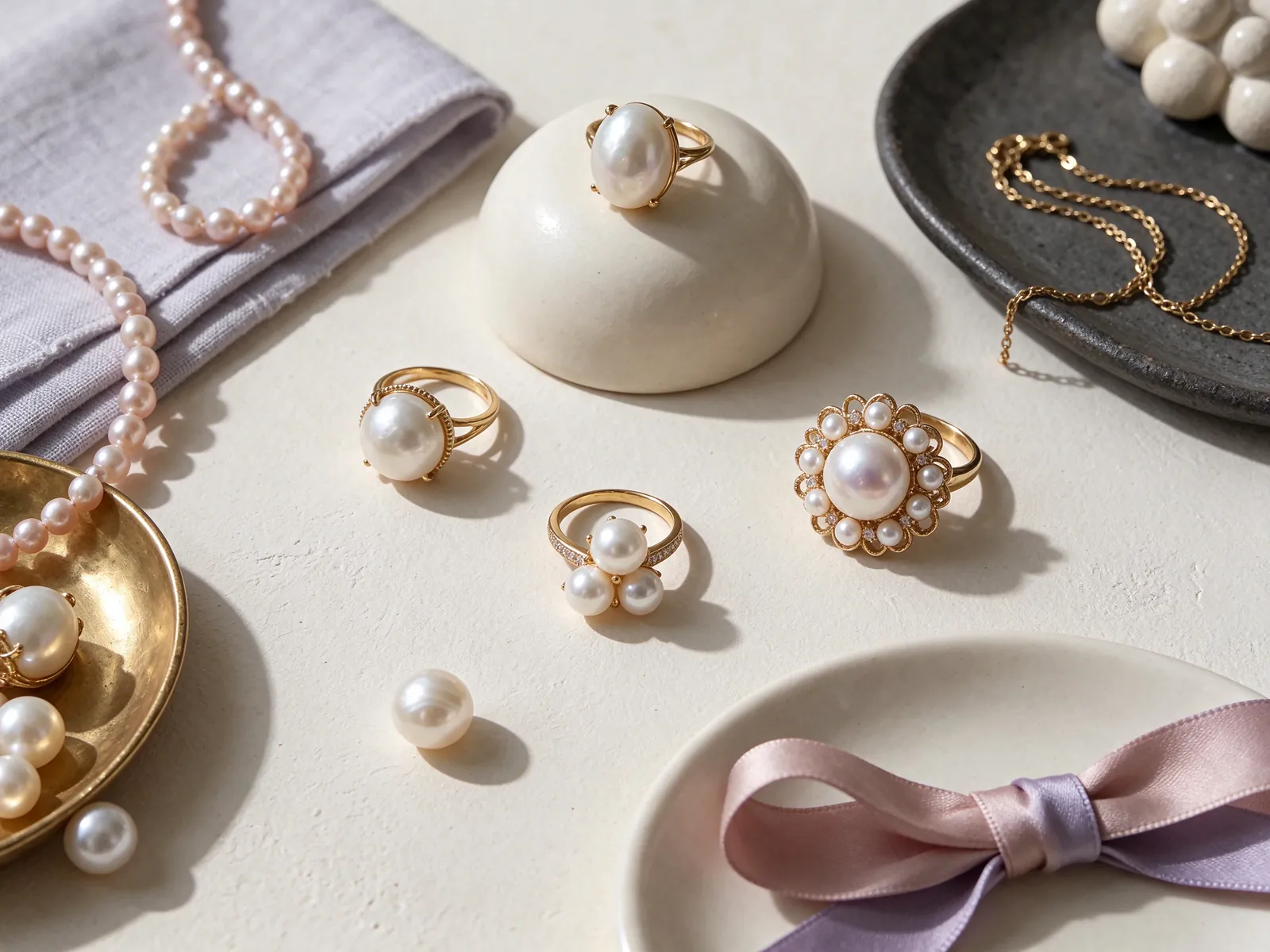
Read the pearl details independently of the design
The phrase Akoya butterfly ring includes a pearl description and a motif description, but it is not a complete record of an individual pearl. Separate questions about the pearl from questions about the wings and band. A round, white appearance in a photograph cannot establish pearl type, origin, treatment status or natural-versus-cultured identity. Likewise, details associated with a different ring do not describe the ring in front of you.
GIA identifies seven pearl value factors: size, shape, color, luster, surface quality, nacre quality and matching. For this motif, look at whether the pearl remains visually distinct beside reflective wing details, and inspect its shape and visible surface from different angles. Matching becomes more relevant when several pearls appear together; a single-pearl design should not be judged as though it were a matched strand.
Look beyond a bright display reflection
Compare soft daylight with ordinary indoor lighting, deliberately looking at the pearl rather than only the shine of the wings. Consider whether its visible color works with the clothing you actually wear. GIA distinguishes bodycolor, overtone and orient, and notes that not every pearl has all three. A color description therefore needs to be read carefully rather than treated as a promise of one effect in every setting.
Test how the whole construction meets your hand
Band fit is only part of comfort. A wing tip may touch the next finger, a raised pearl support may meet a sleeve, or the underside may become noticeable when you hold something. Try ordinary, gentle movements such as writing with a pen and holding a cup. If there is pressure or scraping, identify the contact point instead of relying on the idea that you will simply get used to it.
An open ring should not be treated as a ring you can bend to size. Changing the distance between its ends can affect the position of a pearl support, wing or setting. Ask whether this particular structure can be resized, what part would change and whether the face's orientation would be affected. Similar outlines do not guarantee similar resizing options or outcomes.
Check a familiar cuff without forcing it
Try the ring with a shirt or knit sleeve that belongs in your normal wardrobe. Gently move the cuff past the face to see which edges meet the fabric, without tugging to test strength. If your activities include frequent firm gripping, decide when the ring would be removed; a realistic wearing plan is more useful than judging the design only on a bare hand.
Build an outfit around the butterfly's presence
For an everyday outfit, let the butterfly be the main hand detail first, then add other jewelry only if it leaves the outline clear. Stacking two raised faces can create a collision or cover part of a wing. Inspect the space between them while your hand is still and while your fingers bend. The ring arrangement needs to work during movement, not just in a close-up picture.
For an evening outfit, a pearl cocktail ring offers a comparison when you want a more noticeable focal point. A pearl and diamond ring brings attention to the proportion of pearl and set stones, while a pearl halo ring explores an arrangement surrounding the pearl. Decide whether your outfit calls for surrounding accents or the directional butterfly outline; more visible detail is not always a better balance.
Use a full-outfit view and a detail view
Step back from a mirror to see whether the wings or pearl remain the focal point. A busy sleeve pattern may compete with small details, while a simple cuff can make the silhouette easier to recognize. Then inspect the close view for overlap with other rings. Distance tells you about overall presence; the close view tells you whether the details still have room.
Protect the pearl surface and avoid pulling on wings
GIA lists pearl at 2.5 on the Mohs hardness scale. That figure supports careful handling of the surface, particularly when a ring can meet hard objects during hand movements. It does not predict the life of the whole ring or guarantee impact resistance. Keep the ring separate in storage so metal edges and other gemstones do not rub against the pearl.
Wipe the pearl after wear with a very soft, clean cloth, and avoid perfume, hair spray, acids and excessive heat. GIA says pearls should never be cleaned with ultrasonic or steam cleaners. A small gap beside the wings is not an exception. Avoid scraping near the pearl with a sharp implement; difficult buildup calls for advice on a cleaning method compatible with the ring's construction.
Release caught fabric before removing the ring
If a wing catches a sleeve, stop pulling and relax the fabric before separating it carefully. After removing the ring, check whether the outline has changed or the pearl shows visible movement. If anything appears altered, stop wearing it and seek a suitable professional assessment. Hand-bending a wing back into place is not a substitute for checking the structure.
Make the final comparison about your actual needs
List the outline you want, the finger you plan to use, the activities and sleeves involved, and the pearl details you want explained. Photos of your hand in a relaxed position can help communicate the proportions you prefer. Compare one major feature at a time, such as wing direction or face height, rather than changing every feature at once and losing track of why a ring feels better.
If the ring is a gift, learn whether the recipient likes a wide motif and how she wears rings during work. A butterfly may reflect an interest in nature without needing a fixed symbolic meaning. If movement is the real attraction, compare a pearl charm ring instead of treating a fixed wing and a hanging detail as equivalent; they bring different clothing-contact and styling questions.
Frame questions around a movement you want to make
Explain that you want to write without pressure on an adjacent finger, or that you want the pearl visible while your hand rests naturally. Those examples are more precise than asking only for a light-looking design. Keep practical fit needs distinct from color and motif preferences, then return to the try-on to decide whether the attractive outline also fits your routine. To discuss selection questions about butterfly outlines, wearing direction and ring fit, contact Flint Jewelry on WhatsApp or call +85260106207.
| Feature | Decision point | Gentle try-on check | Outfit consideration |
|---|---|---|---|
| Pearl and wings | Which element leads visually | Rest the hand and inspect the side view | Keep the focal point visible |
| Outer wing tips | Clearance from adjacent fingers | Open and lightly bend the fingers | Leave space beside another ring |
| Raised profile | The highest point of the face | Move a familiar cuff past the motif | Check shirts and knitwear |
| Band and open ends | Resting position and structure | Write without holding the face straight | Do not assume self-adjustment |
| Pearl appearance | Luster, color and visible surface | Compare daylight with indoor light | Coordinate with your usual jewelry |
Pearl knowledge and authoritative references
GIA lists pearl at 2.5 on the Mohs hardness scale. This is a pearl-surface care fact, not a prediction of a butterfly ring's lifespan or a guarantee against damage.
Read the reference for this factFrequently asked questions
Does the butterfly have to point toward the fingertips?
No universal orientation applies. Try it toward the fingertips and toward the wrist with a relaxed hand. Check both the visual sequence of pearl and wings and the way the tips meet your sleeve.
Can a photo confirm that the pearl is Akoya?
A photo alone cannot establish pearl type or identity. Read the information for the individual pearl separately from the motif name; a white, round appearance is not enough to establish origin, treatment status or natural-versus-cultured identity either.
Is an open butterfly ring automatically adjustable?
No. Open ends may be part of a fixed construction, and moving them can affect the pearl support or wing details. Resizing options require assessment of that ring rather than an assumption based on its shape.
What should I check before stacking a butterfly ring?
Look for room between the raised faces, then gently bend your fingers. Repeated contact with a wing or pearl is a reason to separate the rings. Also check whether the second face hides the butterfly outline you wanted to show.
How should I handle dirt beside the pearl support?
Use gentle routine care and ask about the specific construction if the area is difficult to reach. Do not scrape the pearl edge or use ultrasonic or steam cleaning; GIA advises against both cleaner types for pearls.
Updated: