
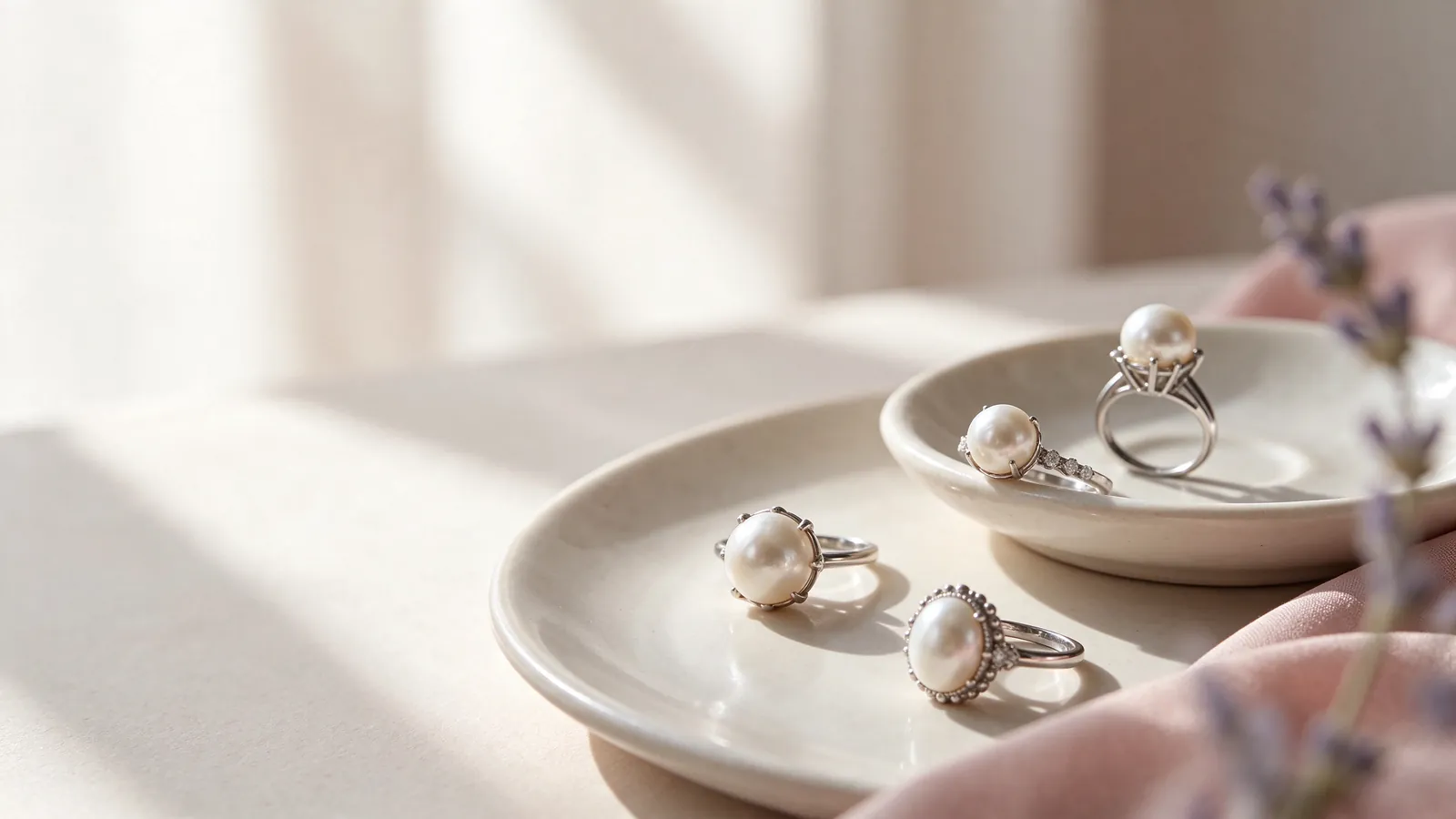
What face proportions should you compare in the pearl signet design of an Akoya pearl signet ring?
Look first at how the face frames the pearl. A broad oval, rounded square and elongated rectangle place different amounts of metal around the focal point. On the hand, consider whether that frame remains visible and whether its edges extend awkwardly beyond the finger. The design may suggest a signet through its face and shoulders without providing a usable stamping surface. A comparison across pearl rings can help identify whether you really want the strong face outline or simply enjoy a pearl as the main feature of a ring.
Next, compare photographs that answer different questions. A close-up explains small details, a full hand view shows scale and a profile reveals height. None should be treated as a substitute for the others. In a description of an Akoya pearl signet ring, the pearl name does not establish how wide the metal face is, how the pearl is attached or how far it rises above the finger. Evaluate those construction features directly so that an appealing overhead image does not conceal a profile unsuited to your routine.
When assessing pearl signet design for an Akoya pearl signet ring, how do band width and setting height affect fit?
During a fitting, extend your fingers, make a relaxed fist and hold a pen. Separate pressure from the shoulders, looseness at the finger base and contact from a raised setting. They are different problems. A larger size might ease band pressure but allow the face to rotate; a smaller size might reduce movement but make the knuckle difficult to pass. Describe the specific sensation before deciding what to change.
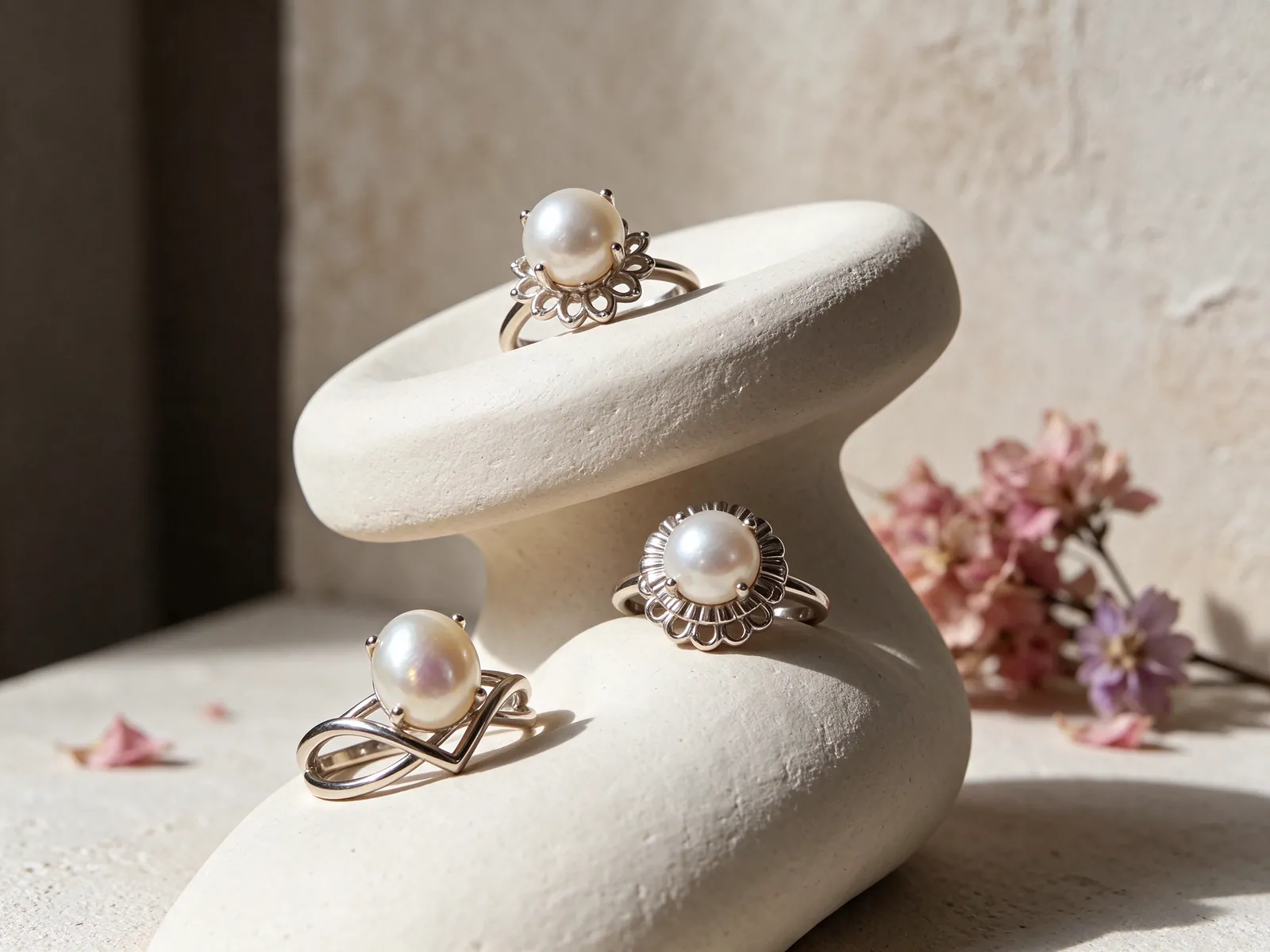
Match the silhouette to the intended finger and hand
Think about the hand that performs your usual tasks. An index-finger ring may meet bag handles and objects you grip; a middle-finger ring must leave comfortable space beside both shoulders. Rather than following a fixed styling rule, compare the same general outline in the position where you intend to wear it. Check how naturally your fingers bend and whether the ring changes the way you hold a phone. The strongest visual placement is not necessarily the most convenient one for daily wear.
The pearl pinky ring guide offers a useful alternative when your preferred position is the little finger. A smaller ring size alone does not redesign a broad face for that narrower space. Look for overhang and rotation, then rest the hand naturally to see where the face settles. When gripping a phone or placing your hand on a surface, notice whether the outer edge presses against the palm. These checks reveal practical differences that a posed hand photograph can miss.
Do not transfer a narrow band's fit without comparison
A familiar ring can suggest a starting size, but a broad signet band contacts the finger differently. Where possible, compare a fitting band with similar width and an appropriate inner contour. Assess the ring at the finger base as well as at the knuckle. A ring that slides off easily may still rotate during wear, while one that stays upright may be uncomfortable to remove. Both stages matter.
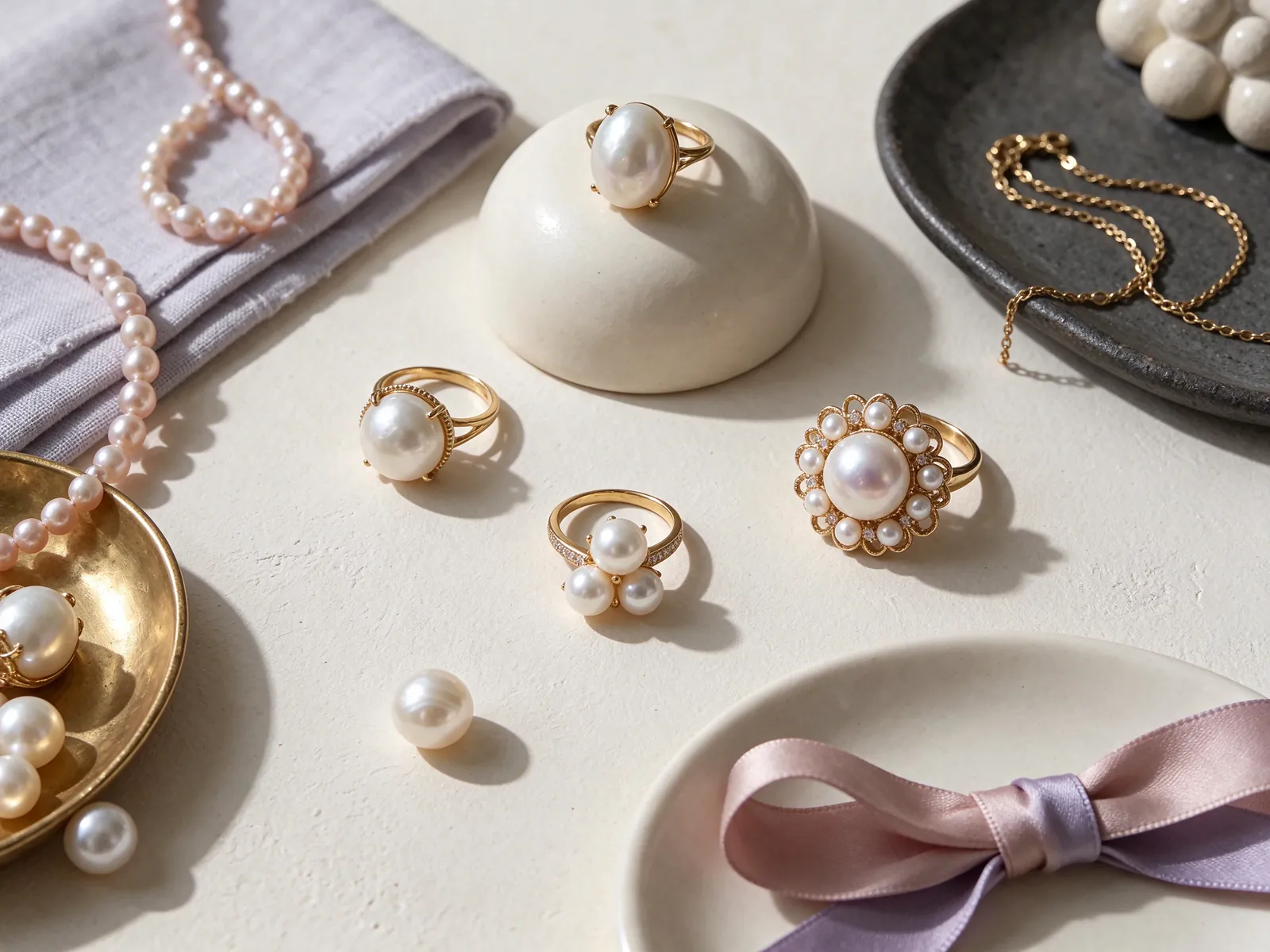
Use pearl placement to decide how geometric the ring should feel
A centered pearl tends to create an even relationship with the surrounding face. An offset pearl introduces direction and leaves a more visible metal area on one side. Turn the hand and look from the wrist as well as from the fingertips: the same composition may read differently from each direction. The pearl's outline can soften a strong frame, but shape is a design observation, not proof of origin, identity or treatment. Keep those factual questions separate from your visual preference.
The shoulders also contribute to the effect. A pronounced straight transition can emphasize geometry, while a curved one may create a gentler outline. If you find yourself drawn to petal-like details, compare a pearl flower ring and decide whether a recognizable floral motif is actually the goal. A subtle rounded signet and a flower-shaped face are not the same visual statement. Judge details at a normal viewing distance as well as in close-up so that the chosen outline, rather than an enlarged photograph, drives the decision.
Ask what the profile shows about exposed surfaces
In profile, examine the space below the pearl, projecting metal edges and the shape of the shoulder transition. Low height does not mean every pearl surface is protected, and a metal border does not establish resistance to every impact. Ask how the pearl is secured and what inspection involves. Then decide whether the exposure and construction make sense for the activities during which you intend to wear it.
Read pearl information without turning a name into a grade
Akoya describes a pearl type; the word alone does not establish a quality grade or the inclusion of a certificate. Ask about the actual pearl information separately from the ring's dimensions and construction. If documentation accompanies a selection, read which pearl it identifies and what the document states. Do not let a product heading answer a question that belongs to a report. For a visual color comparison, keep lighting and background similar so that changes in surrounding reflections do not dominate the impression.
GIA identifies seven pearl value factors: size, shape, color, luster, surface quality, nacre quality and matching. In a single-pearl signet composition, the quality of reflections and the surfaces visible on the hand are useful areas to discuss. Matching can matter when several pearls share the design or when you are choosing companion jewelry. These factors are not a checklist that automatically produces a grade. Bright lighting alone does not demonstrate strong luster, and a flattering angle does not describe every part of a pearl's surface.
Ask questions that can be answered with actual information
Replace a broad question such as whether the pearl is premium with questions about recorded size, visible surface features and any accompanying documents. Describe the reflection and color impression you enjoy under your usual lighting. That helps communicate taste without claiming to identify the pearl yourself. Natural-versus-cultured identity, origin and treatment status cannot be settled solely by the way a finished ring looks.
Build an outfit around the face instead of crowding it
With a crisp shirt or structured jacket, a defined signet outline can repeat the clothing's lines while the pearl adds a softer element. Start by treating the face as the main feature on the hand, then decide whether anything else is needed. Check the sleeve in motion, not just the color pairing. Gently move a cuff over the ring and note where it catches. A knitted sleeve may react to an exposed edge even when the overall height looks modest.
If you want additional rings, inspect contact before choosing a visual combination. An open pearl ring can introduce negative space, but the open appearance should not be interpreted as permission to bend it repeatedly for resizing. A multi pearl ring gives another point of comparison by distributing attention across several pearls. That may help you decide whether stacking would add interest or simply compete with the signet face. Separate fingers or hands can prevent an adjacent metal edge from repeatedly meeting the pearl as your fingers move.
Consider surface finish as part of the complete design
When discussing metal choices, keep the options to 18K 750 white gold, 18K 750 yellow gold, 18K 750 rose gold, PT950 platinum and PT900 platinum. Compare the intended finish with the pearl's visual color rather than relying on a metal name to predict the finished appearance. Metal selection alone does not determine the ring's profile, stability or stacking clearance. Those depend on the complete design you are assessing.

Clarify the purpose of engraving and other personal details
For an inscription, first decide whether it should be visible while the ring is worn or placed inside the band. The available metal area and the pearl attachment influence what is practical. A long name can crowd a small face, while a shorter mark may leave the outline clearer. The pearl is not an ordinary metal surface for engraving. Personal meaning can also come from the composition itself; a signet-inspired style does not need to function as a seal to be significant.
If the appealing detail is movement rather than a fixed frame, compare a pearl charm ring. A mobile element changes direction and has different contact points around sleeves, other rings and objects held in the hand. That behavior is distinct from a pearl fixed within a signet composition. Decide whether you want a steady geometric focus or a moving detail before choosing between them. The presence of a pearl in both styles does not make their everyday wearing experience equivalent.
Use the recipient's habits to guide a gift
For a gift, notice which finger the recipient uses for rings, whether they favor broad or narrow bands and what their daily tasks involve. An existing ring offers clues to style, but its size should not be transferred automatically to another finger or a wider construction. If an inscription matters, settle its wording and intended location. If ease of wear is the priority, focus first on fit and profile rather than assumptions based on age or gender.
Choose a wearing routine that respects the pearl surface
Hands bring a ring into contact with desks, handles and objects throughout the day. GIA lists pearl at 2.5 on the Mohs hardness scale, which is relevant to protecting its surface from scratches. It is not an impact tolerance or a promise about how many knocks the ring can survive. Remove the ring before rough handling, household cleaning or activities likely to hit the face. A substantial-looking metal frame should not be confused with the pearl's own resistance to abrasion.
Wipe the pearl after wearing with a very soft, clean cloth, and store it separately from jewelry that could rub against it. GIA advises that pearls should never be cleaned with ultrasonic or steam cleaners and should be kept away from acids, perfume, hair spray and excessive heat. A cleaning method suitable for another decorative element may be unsuitable for the complete ring. Consider the pearl and its setting together, including areas near the base that are not easy to inspect from above.
A change in pearl position calls for inspection, not improvisation
If the pearl feels loose, turns from its usual direction or starts catching on clothing, stop wearing the ring and arrange an appropriate setting inspection. Avoid twisting the pearl or applying household glue. Note when the change appeared and whether a specific knock or activity preceded it. That account helps explain the problem without requiring you to scrape the setting, diagnose the attachment or choose a repair technique.
To discuss how a signet-inspired outline might suit your routine, contact Flint Jewelry on WhatsApp at +85260106207 about pearl ring selection. Your intended finger, everyday sleeve styles and engraving ideas are useful starting points for a conversation about proportions and comfort.
| Design feature | Check from above | Check in profile | Test on the hand | What it helps decide |
|---|---|---|---|---|
| Face proportions | Width, length and visible metal frame | Transition from face to shoulders | Extend the fingers naturally | Whether the silhouette suits the finger |
| Pearl placement | Centered versus offset composition | Exposed surfaces and space beneath | Move a cuff gently past the face | Balance and potential contact points |
| Band fit | Whether the face stays oriented | Inner contour and shoulder shape | Hold a pen and make a relaxed fist | Size issue versus construction issue |
| Stacking space | Combined visual emphasis | Contact between ring edges and pearl | Bend adjacent fingers together | Whether to separate the rings |
| Care routine | Changes in surface appearance | Changes in pearl position | Remove before rough activities | How to reduce scratching and avoid unsuitable cleaners |
Pearl knowledge and authoritative references
GIA gives pearl a Mohs hardness of 2.5. This is relevant to scratch protection for a ring worn on an active hand, not a measure of impact resistance.
Read the reference for this factFrequently asked questions
Can I use a pearl signet ring to stamp sealing wax?
Do not assume that it is a functional seal. The signet character may be an outline rather than an engraved stamping face. Pressing a pearl into wax introduces contact and possible heat that are inappropriate for pearl care. Treat a working seal as a separate tool requirement.
Why might a broad face turn even when the size feels comfortable?
The balance of the face, band shape and difference between the knuckle and finger base can contribute to movement. Watch the ring while your hand is relaxed and while holding an object. A size change is not automatically the answer, particularly if a smaller band would be difficult to pass over the knuckle.
Is the inside of the band always the best place for a name?
It depends on the available metal space, the setting and whether you want the name visible while worn. A face inscription may compete with the pearl, while an inside inscription has its own space and readability limits. Decide the purpose first, then discuss a position that works with the construction.
Does the Akoya wording identify the documents I will receive?
No. The pearl-type wording does not establish which documents accompany a ring. If paperwork is important, ask what is provided, what it records and which pearl it concerns. Neither the style name nor a photograph can establish those details.
What should I check before pairing it with a wedding ring?
Check whether the other ring's edge touches the pearl when the fingers bend. Contact matters before matching color or finish. If the bands repeatedly meet at the pearl surface, wearing them on different fingers or hands may be a better arrangement than stacking them together.
Updated: