
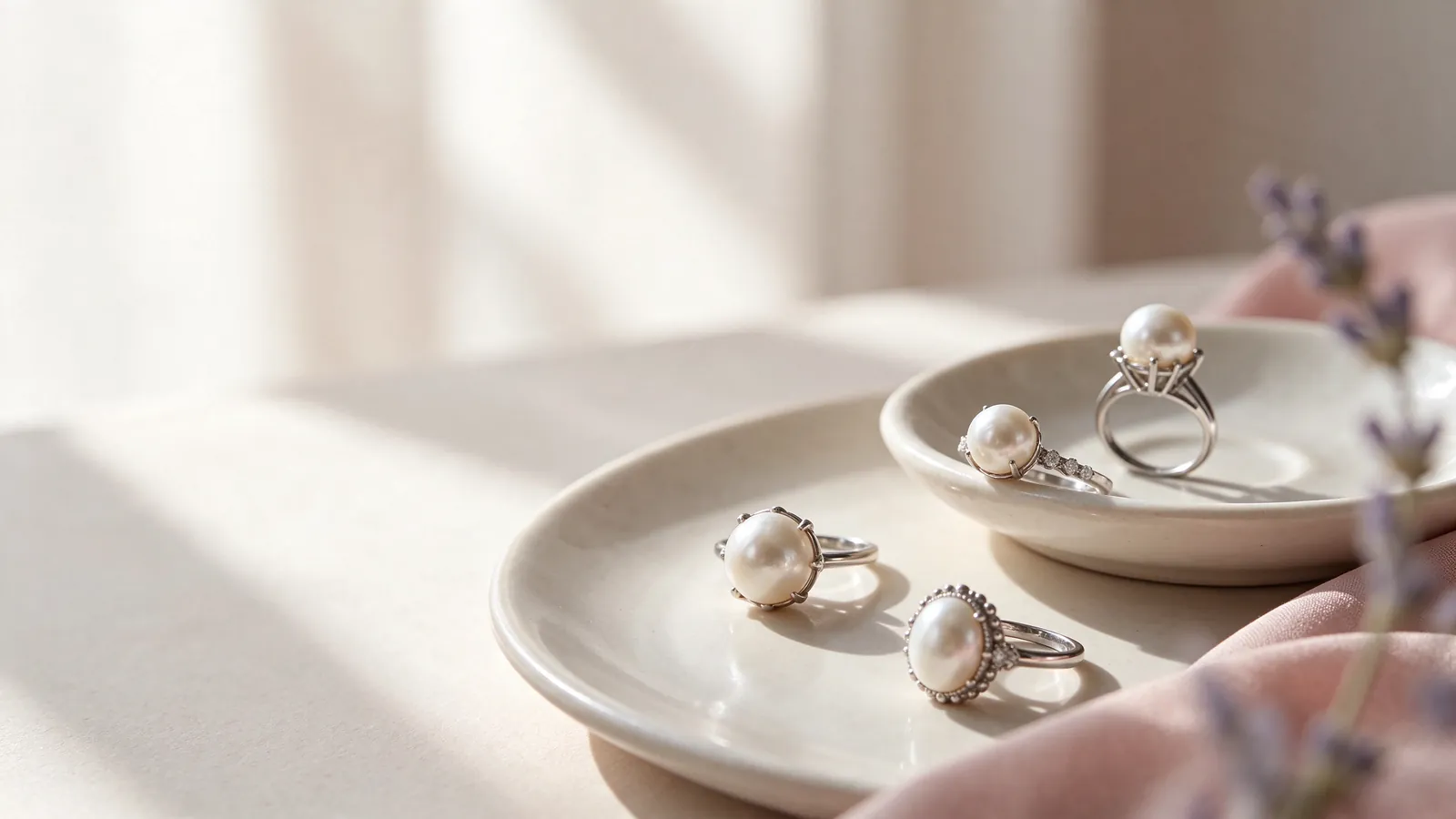
What do the outline and pearl arrangement contribute to the visual balance of a pearl tiara ring, a pearl crown ring or a tiara shaped pearl ring?
Begin with the entire shape, not the smallest decorative detail. A crown-inspired ring creates a rising and falling upper line, sometimes with a taller center and sometimes with several repeated peaks. A central rise can lead the eye toward the fingertip; a broad arrangement can make the ring feel more horizontal. The choice depends on the effect you like on your own hand. A striking close-up is useful for seeing details, but it cannot answer that proportion question by itself.
Next, ask whether the pearls trace the crown or sit within a shape formed largely by metal. That distinction changes how the eye reads the design. Spaces between pearls and supports can be as important as the elements themselves, especially if you prefer a lighter-looking outline. Comparing pearl rings across different structures helps you decide whether the attraction is specifically the crown edge, the pearl arrangement or simply the presence of a decorative ring face.
How can you check size and contact with adjacent fingers when trying on a pearl tiara ring, a pearl crown ring or a tiara shaped pearl ring?
Check the band at the base of the finger, then bring adjacent fingers together and bend your hand gently. Identify whether contact comes from the band or the crown's outer edge. A larger size may not fix a broad setting and could make it turn more readily. Treat these as separate fitting questions.
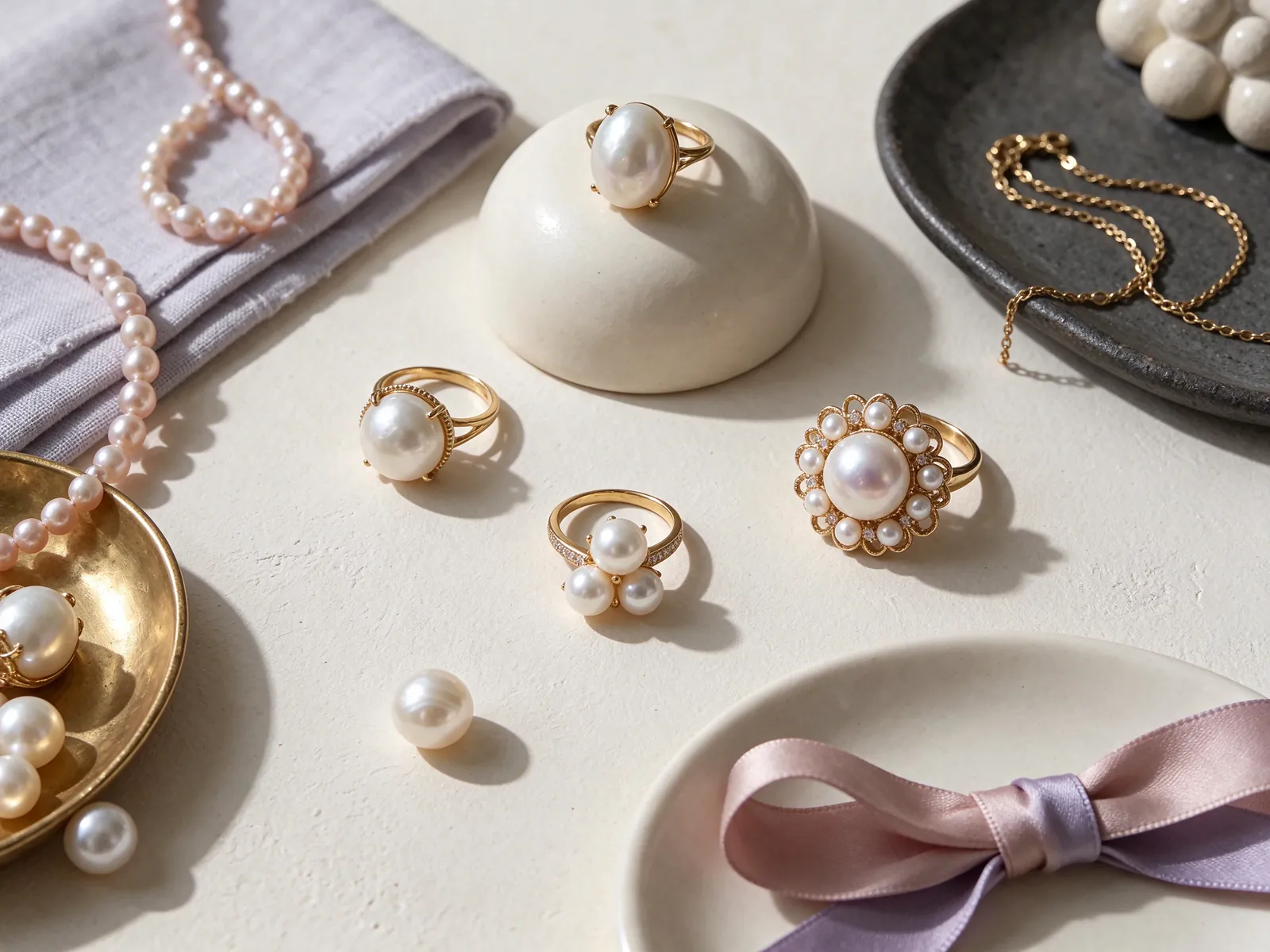
Translate a style preference into visible design features
Words such as romantic, delicate or dramatic are a starting point, but visible features make them more useful. Decide whether you prefer rounded arches, pronounced points or a fine sequence of small rises. Look at the open areas beneath the upper line and whether the outside edges project beyond the pearls. A design can appear airy without being unobtrusive around clothing. Consider your usual cuffs and sleeves, and simulate ordinary dressing movements rather than dragging fabric across the setting as a test.
Compare the crown with other motifs to clarify what matters. A pearl flower ring draws elements toward a center, while a pearl butterfly ring spreads its outline to either side. A crescent moon pearl ring creates a directional curve rather than a repeated upper rhythm. These comparisons are not substitutes for a crown design; they help identify whether you enjoy peaks, symmetry, a sweeping line or simply decorative detail. Knowing that preference prevents the motif's name from making the decision for you.
Read images for shape, not implied measurements
A straight-on view shows the arrangement; a side view shows how far it rises from the band. Hand photographs add context, but camera angle and distance affect apparent scale. Compare views taken from similar positions and obtain actual width and height information separately when those dimensions matter to your choice.
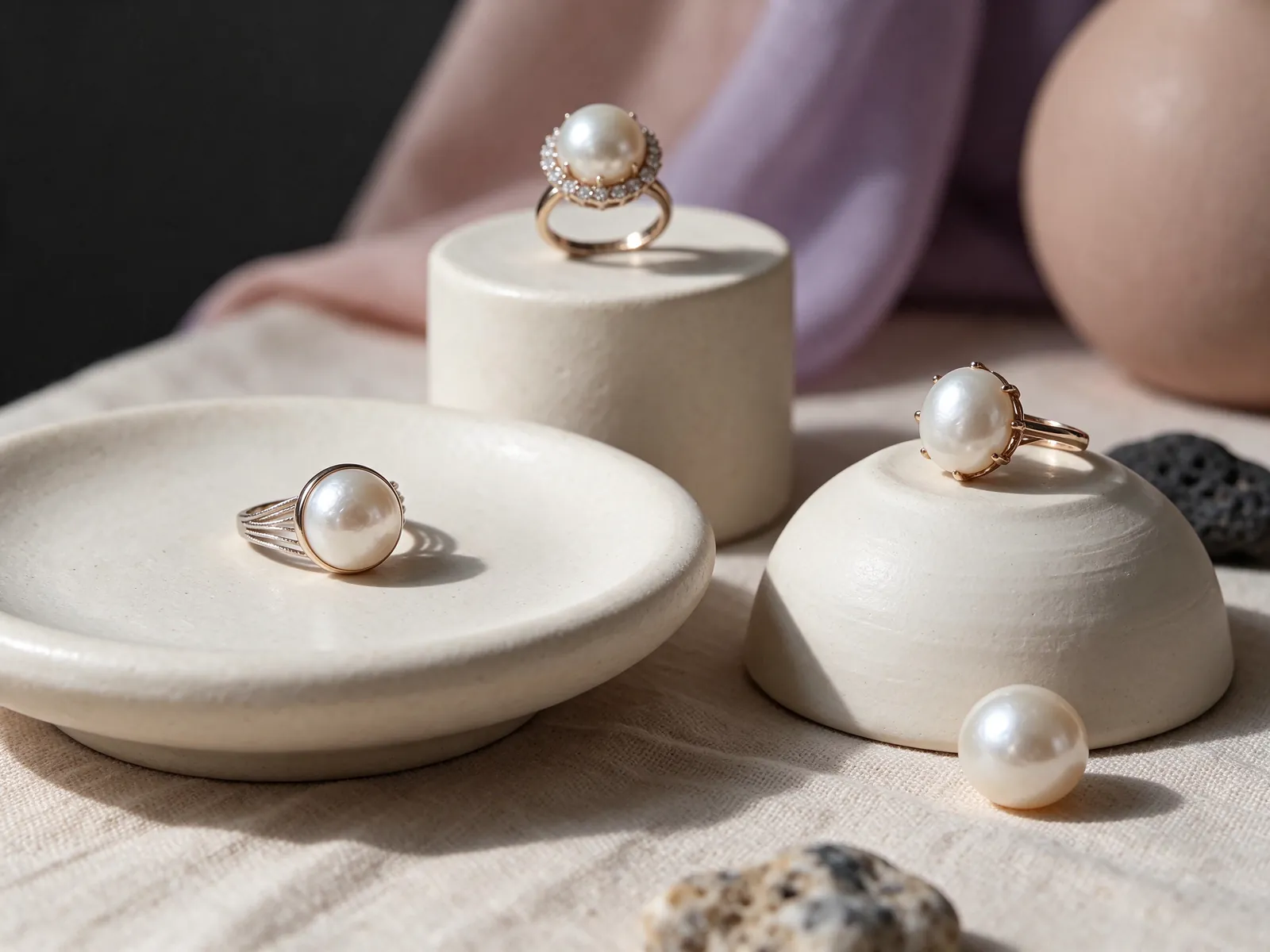
Make the side profile part of the try-on
Two rings with similar front outlines can behave differently because of their side profiles. Look for the highest point, the position of the supports and any crown ends extending toward neighboring fingers. Let the ring settle without holding it straight. If it rotates, consider the setting's balance and band shape as well as size. The way a ring rests is an interaction with your finger, not something that can be understood from a front photograph alone.
Use familiar, gentle movements during the fitting: holding a phone, bending a finger as if typing, or lightly closing the hand. Notice whether the setting presses against another finger or meets the palm when you bend. A lower profile may be more convenient for certain routines, but it does not make pearls immune to impact. Think about when you are prepared to remove the ring rather than seeking a decorative style that is supposedly suitable for every activity.
Explain both knuckle passage and resting fit
The effort needed to pass the knuckle can differ from the fit at the finger's base. Check both putting the ring on and wearing it with the hand relaxed. Because hand conditions vary, a brief try-on is not a universal fit test. Describe where resistance or looseness occurs rather than giving only a size judgment.
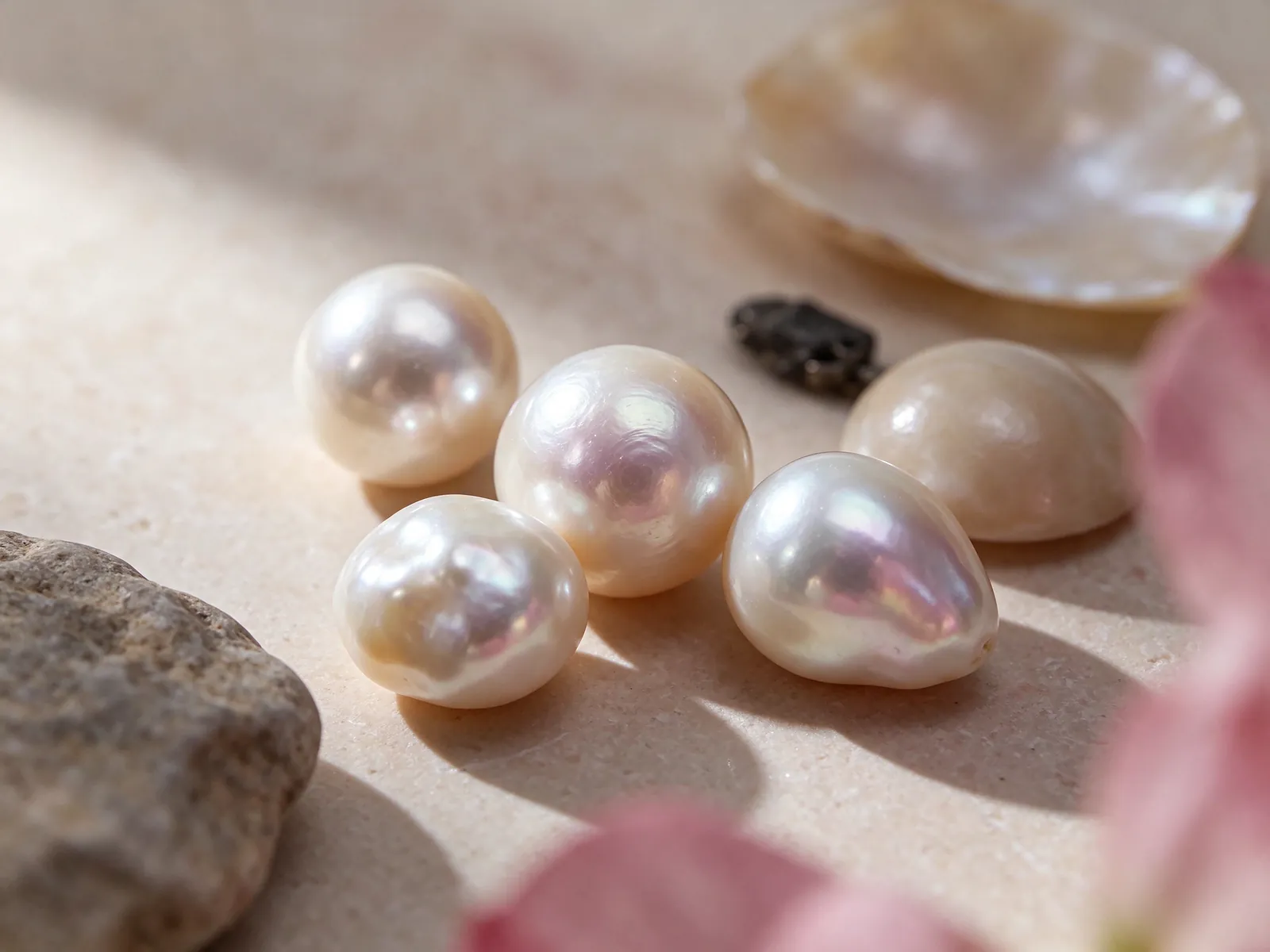
Evaluate the pearls without confusing arrangement with identity
A repeated crown arrangement puts pearls next to one another, so it is useful to compare them as a group and individually. In gentle light, look at reflection clarity, visible surface features and the relationship between colors. A graduated design may intentionally vary its elements; matching is then about a coherent progression rather than identical appearance. Decide whether those differences support the outline or interrupt it. An orderly row can be visually appealing without telling you everything about the pearls.
GIA identifies seven pearl quality factors: size, shape, color, luster, surface quality, nacre quality and matching. The framework explains why neither neat placement nor a single attractive color is a complete quality judgment. Shape and color alone do not establish origin or natural-versus-cultured identity. Read pearl details separately from the crown-style description and from the metal description. A motif name is not a certificate, a pearl type or a promise that every element has the same characteristics.
Avoid turning size language into a pearl category
Small pearls may create a fine upper edge, but small is an appearance description, not an identity. Baby should not automatically be equated with seed or Keshi. If a particular pearl type is important to you, look for an explicit description rather than guessing from the crown's proportions or a photograph.
Choose a focal point before adding another ring
A crown outline can carry a look on its own. Before adding more jewelry to the same hand, consider the space occupied by a bracelet, sleeve and neighboring ring. If you are seeking a bolder effect, a pearl cocktail ring is a useful comparison for overall visual scale. Ask whether you want a larger face or finely worked detail within a smaller face. Those preferences can lead to different choices even when both options feel decorative.
Stacking needs a clearance check, not just a pleasing arrangement in a photo. Look from the side for contact between the second band and the pearls, their supports or the crown points. Check again as the finger bends. A pearl and diamond ring can help you compare bright accents with the continuous pearl rhythm, but attractive visual contrast does not justify rubbing settings together. When the pieces touch, separate fingers or opposite hands give each design room without forcing a close fit.
Let wearability guide the direction of the crown
Try the points facing the fingertip and then the palm, watching both the outline and how the edges behave during bending. A direction does not require a wedding rule or guaranteed symbolic meaning. Where the structure permits both positions, choose the one that suits your personal view and hand movements.
Plan care around exposed pearls and crown edges
GIA lists pearl at 2.5 on the Mohs hardness scale, making everyday care a relevant part of selection. Raised crown elements may be the first part of a ring to meet an object. Remove the ring before exercise, moving items or chores likely to cause abrasion or impact. Keep pearls away from acids, perfume, hair spray and excessive heat. These are sensible exposure precautions, not a claim that careful wear guarantees permanent appearance or makes any ring damage-proof.
Use a very soft, clean cloth to wipe pearls gently after wearing. Inspect the spaces in the arrangement for residue without poking them with a sharp object or tugging at attachments. GIA advises that pearls should never be cleaned in ultrasonic or steam cleaners. Store the ring apart from jewelry that might press hard surfaces against the pearls. If a pearl becomes loose or a support appears bent, set the ring aside and ask how that construction should be handled.
Know whether the ornament is meant to move
A fixed crown row and a pearl charm ring have different movement considerations. A charm needs room for its intended swing; fixed pearls need protection of their supports. Do not push a fixed pearl to create movement or assume movement by itself indicates quality. Start by understanding the arrangement's structure.
Bring specific preferences to a style discussion
Prepare a short description of the outline you prefer: central height, total width, open spaces, side projection and crown direction. Add practical context such as the finger you use, frequent typing, sleeve styles and plans to stack another ring. This is more informative than requesting an exact reproduction of a picture. If you find that a clearly framed ring face appeals more than the peaks themselves, compare a pearl signet ring to explore a different way of creating a defined focal point.
After trying a ring, describe what worked and what did not in separate statements. You might like the central rise but prefer narrower sides, or enjoy the pearl spacing but want less projection above the finger. That helps keep comfort questions distinct from visual preferences. Ask about pearl identity separately from matching, and use full material names rather than relying only on metal color. Clear distinctions make the discussion more useful without assuming that a motif implies a particular specification. For material discussions, use the full names 18K 750 white gold, 18K 750 yellow gold, 18K 750 rose gold, PT950 platinum and PT900 platinum; the crown motif does not specify a metal.
For gifts, learn the recipient's wearing habits
The crown motif does not guarantee a suitable occasion or a shared meaning. Find out which finger the recipient prefers, whether they stack rings and how they feel about raised edges. A familiar ring size is only part of the picture: band width and setting shape can change the wearing experience.
To discuss crown-inspired outlines or the fit questions you have noted, contact Flint Jewelry on WhatsApp at +85260106207 with your pearl ring style and sizing questions.
| Feature | What to compare | Try-on action | Style implication |
|---|---|---|---|
| Crown line | Central peak versus a repeated rise | Relax the hand and inspect the ends | Allow the upper edge to remain visible |
| Face width | The full outline on your finger | Gently bring fingers together | Leave room for nearby rings |
| Setting height | Projection and natural resting direction | Hold a phone and bend gently | Check clearance before stacking |
| Pearl row | Luster, color relationships and matching | View the group in gentle lighting | Decide between uniformity and progression |
| Band fit | Knuckle passage and fit at the base | Compare putting on with resting fit | Do not use looseness to solve a wide edge |
Pearl knowledge and authoritative references
GIA's seven pearl quality factors are size, shape, color, luster, surface quality, nacre quality and matching. A crown row makes side-by-side comparison useful, but matching alone does not establish overall quality or pearl identity.
Read the reference for this factFrequently asked questions
Can a pearl crown ring use metal to create most of the crown shape?
Yes, a crown-inspired outline can be expressed through metal curves as well as pearl placement. The important visual question is how the elements form the upper rhythm. The style name does not specify pearl count or type.
Why does a ring look comfortable in a photograph but touch my next finger?
A photograph cannot show your finger spacing or how the edges behave in movement. Compare overall setting width, outward points and band fit on your own hand. Enlarging the ring size is not automatically the answer.
Should the crown points face toward my fingertips?
Try both directions if the construction allows it. Compare the view you prefer and the contact you feel when bending your hand. There is no need to assign a universal ceremonial rule or promised meaning to the direction.
Does the word Baby identify the pearls in a crown row?
It should not be treated as a complete pearl identity or automatically equated with seed or Keshi. Use an explicit pearl description when type matters. Apparent small size and a crown outline are not sufficient identification.
Is a curved gap enough to show that another ring can stack against the crown?
No. Inspect side clearance around pearls and supports, then check while bending the finger. If the pieces rub, wearing them on separate fingers avoids forcing a combination based only on the front outline.
Updated: