
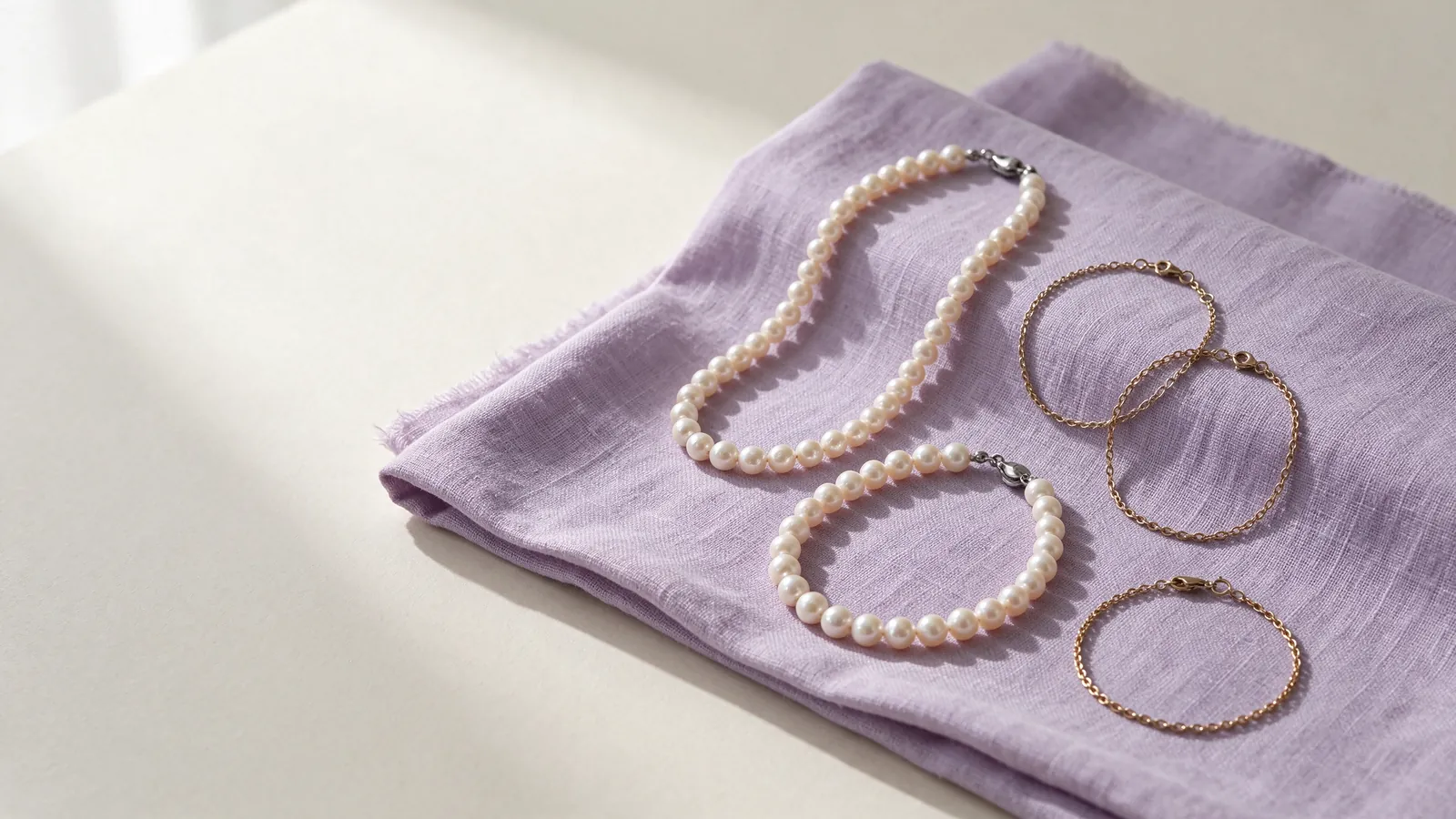
What wrist measurements matter for an adjustable pearl bracelet, a pearl bracelet with adjuster or an adjustable length pearl bracelet?
Start by choosing the position where you normally wear a bracelet: above the wrist bone or nearer the hand. Wrap a flexible tape around that position without compressing the skin or deliberately adding space. Record the location alongside the measurement. If you use a paper strip, keep the join flat before measuring the strip on a ruler. The pearl bracelet size guide helps separate this wrist measurement from the eventual bracelet length, which must also accommodate your preferred feel.
An adjustable pearl bracelet has a usable shortest and longest setting; the word adjustable does not mean unlimited fit. A pearl bracelet with adjuster may change in steps or allow movement between positions, depending on its construction. With an adjustable length pearl bracelet, ask about the positions you can actually use rather than relying on its laid-flat length. Pearls and clasp components occupy space around the wrist, so the internal wearing space is not simply the straightened overall length.
When trying on an adjustable pearl bracelet, how do you assess the clasp and fit of a pearl bracelet with adjuster or an adjustable length pearl bracelet?
Lower your arm, bend the wrist gently and simulate holding your phone or handbag. Notice whether the bracelet slips onto the hand or whether the clasp repeatedly presses against the wrist bone. A closer fit should not restrict movement. A looser fit should not interfere with gripping objects. There is no single allowance that makes every pearl arrangement comfortable, so use these movements to assess your own wearing position.
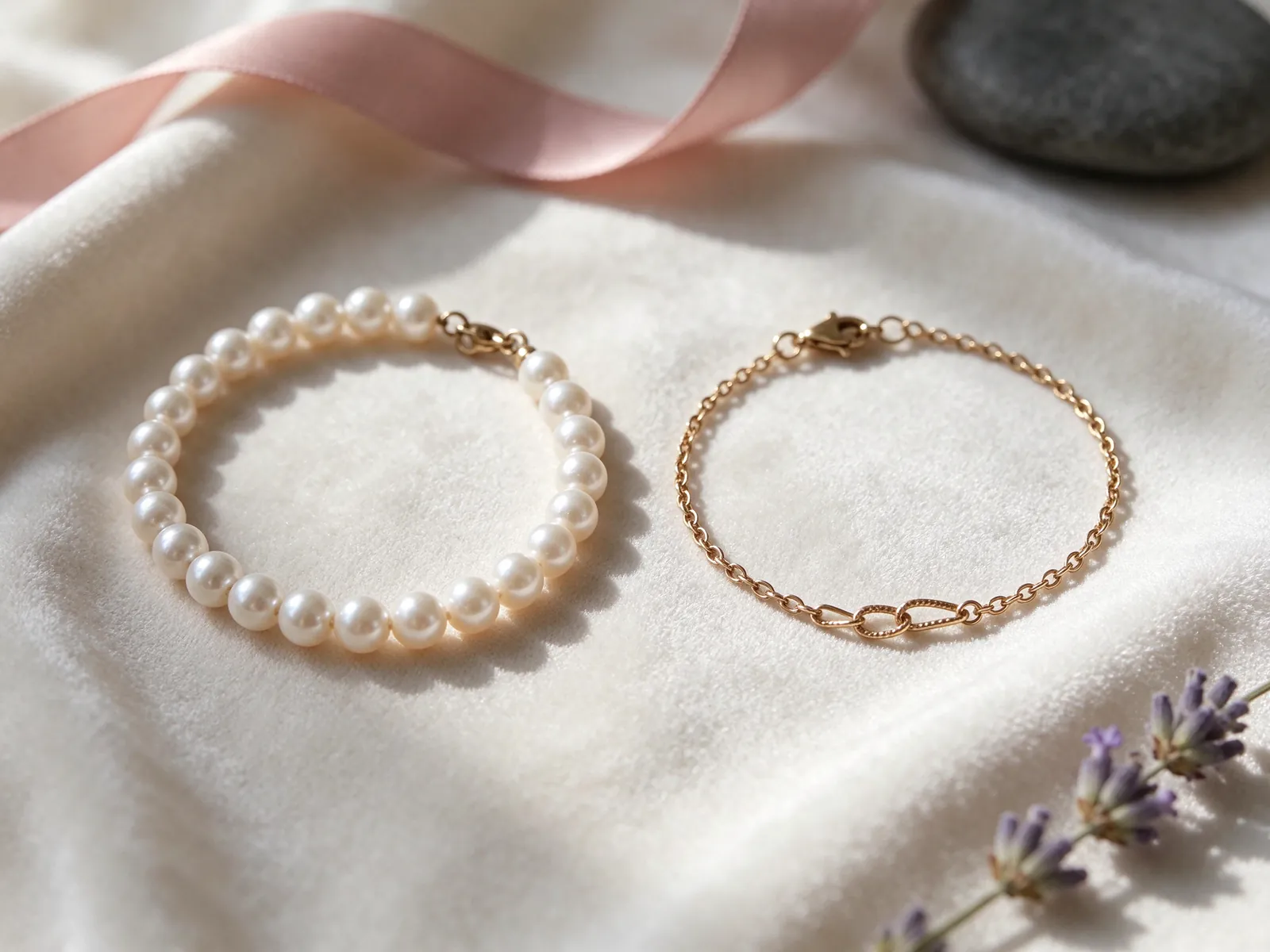
Custom length and an adjustable mechanism answer different questions
Custom sizing establishes a bracelet's finished length during manufacture. It does not, on its own, describe a mechanism that the wearer can alter afterwards. Ask separately how the length is selected and whether the finished piece can be adjusted by the wearer. Removing pearls, restringing or changing a clasp is not the same as routine adjustment before wearing. Keeping these concepts separate makes it easier to compare descriptions without assuming a feature that has not been stated.
An extension chain generally offers selected links for the clasp to engage, while a sliding construction requires its own method of movement, stopping and release. Neither name tells you automatically how easy the mechanism will be for your fingers. Use the pearl bracelet clasp guide to distinguish opening the bracelet from altering its length. A clasp that closes neatly and an adjuster that moves comfortably are related practical questions, but they are not interchangeable.
Find the intended grip before moving the adjuster
Watch the correct operation, then try it on the hand where you intend to wear the bracelet. Do not use the pearls as handles to pull a mechanism into place. Check where the spare tail rests after shortening and whether it twists around the joining point. An operation demonstrated easily by someone facing you may feel different when you are fastening jewellery on your own wrist.
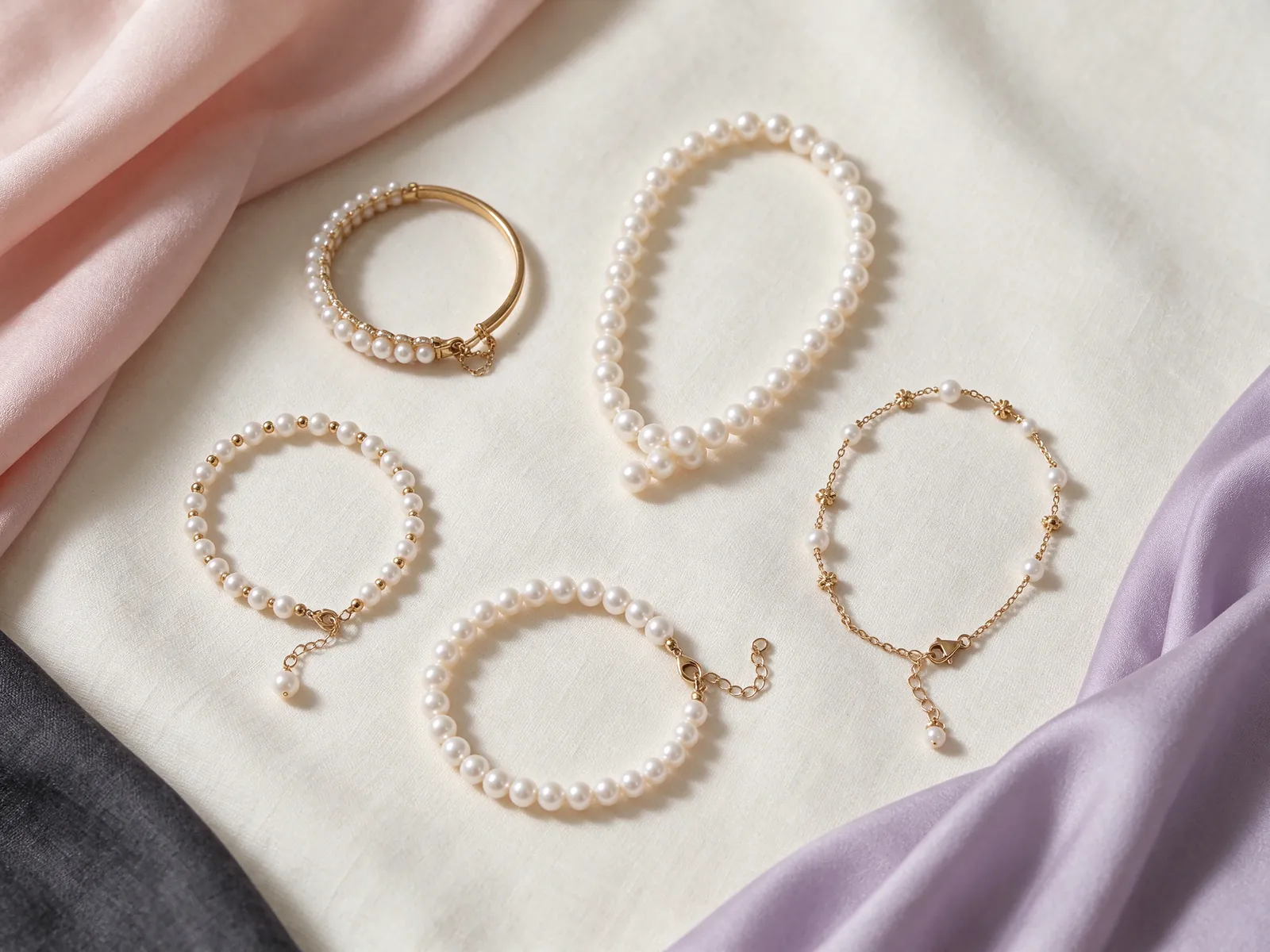
Pearl arrangement changes the way the bracelet follows the wrist
A continuous strand, a design with metal intervals and a multi-strand arrangement can sit differently even when their stated adjustment ranges are similar. Look at how each follows the curve of your wrist. In a multi-strand design, assess the inner and outer strands separately: shortening may bring them closer together without making their drape identical. When comparing a pearl bracelet silhouette, decide whether you prefer a fine continuous line or visible layering, then check whether adjustment preserves that effect.
Fit does not replace an assessment of the pearls. GIA describes seven quality factors: size, shape, colour, lustre, surface quality, nacre quality and matching. For a bracelet, compare neighbouring pearls and their overall visual rhythm in natural light rather than judging brightness from one photograph. An irregular shape can be an intentional design choice. Shape or colour alone cannot establish origin, natural-versus-cultured identity or certification; those questions require the relevant description or documentation.
Check where the decoration sits after shortening
A central motif may move towards the side as the bracelet rotates, so inspect its position with your arm relaxed. If you enjoy a pearl charm bracelet, watch whether the charm and the spare tail gather on the same side or catch each other. Some movement contributes to the style; persistent imbalance that interrupts daily tasks is a different matter. Decide which kind of movement you actually want.
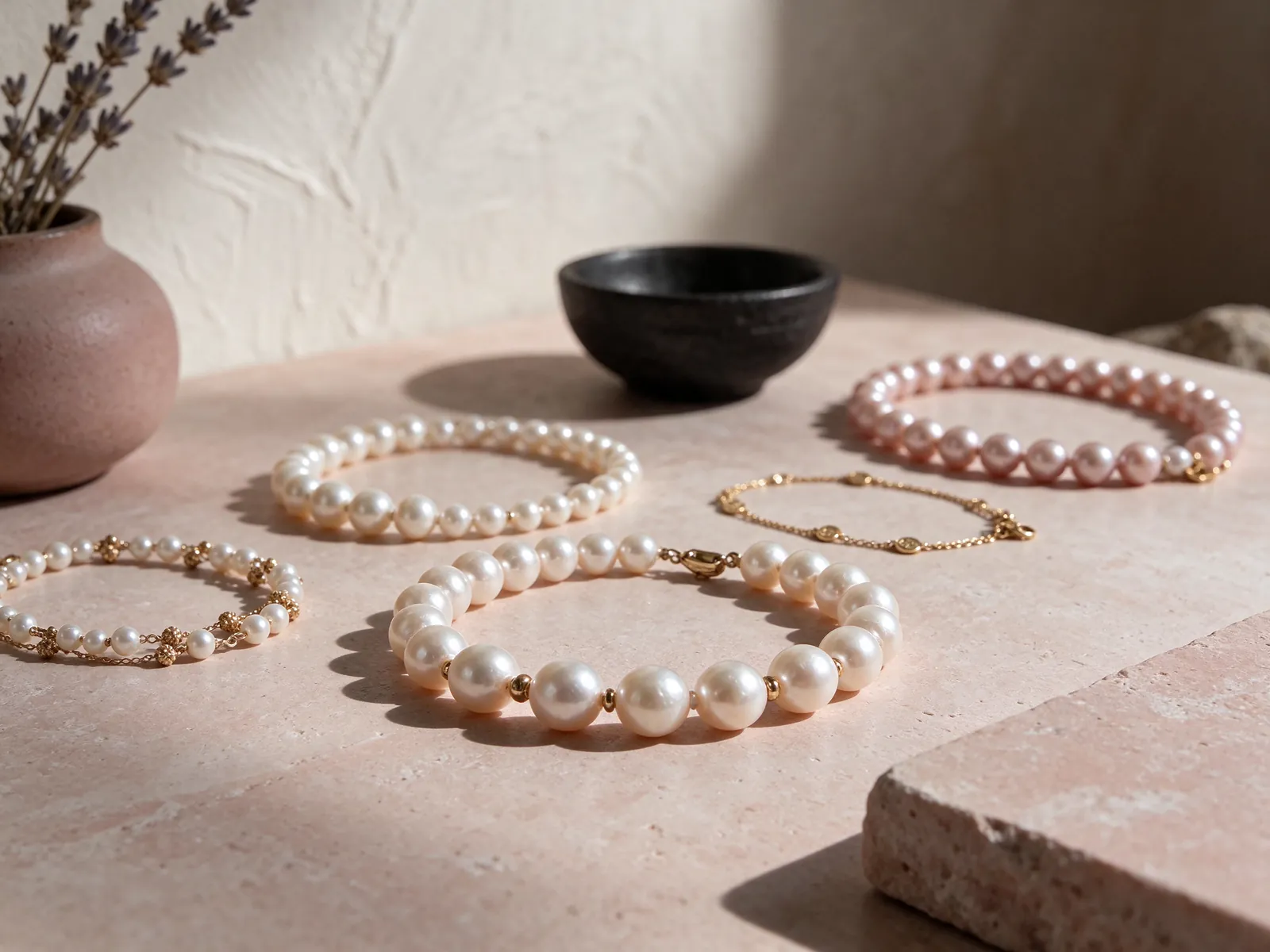
Choose a setting that works with sleeves and desk routines
A fitted shirt cuff can push jewellery towards the hand each time you reach forward. Try wearing the bracelet where it remains visible without being trapped under that cuff. With soft knitwear, pay particular attention to the tail chain and any projecting elements that might catch a stitch. Simply increasing the length may not solve catching; a different wrist position can be more practical. At a desk, notice whether the clasp constantly rests between your wrist and the work surface.
Short sleeves and evening clothes leave more room to show the pearl line, but excessive sliding is not necessary for an elegant drape. If you wear a watch, consider separating the pieces between wrists to reduce repeated contact. A flower pearl bracelet can provide a distinct focal point with a plain cuff; after adjusting, make sure the motif still faces the position you like rather than disappearing underneath. Evaluate the whole outfit with your arm relaxed, not just a posed close-up.
Bring a familiar sleeve into the fitting test
Wear a frequently used shirt or bring a light cardigan when assessing fit. Pull the sleeve down gently and remove the outer layer as you normally would, checking whether the tail follows the fabric. Before an occasion, settle on a comfortable setting rather than tightening for photographs. A bracelet that sits naturally during ordinary movement is a more useful choice than one that only looks tidy in a fixed pose.
Metal colour and finger comfort deserve separate attention
Compare the metal's visual tone with the rings, watch and clothing you already wear. The material choices to consider are 18K 750 white gold, 18K 750 yellow gold, 18K 750 rose gold, PT950 platinum and PT900 platinum; the actual clasp and adjustment construction must be considered separately. The 18k gold pearl bracelet and platinum pearl bracelet guides offer related styling directions. A metal name does not tell you the adjustment range, the position of the tail or how a mechanism will feel in your hand.
Long nails, difficulty gripping small parts or simply a preference for uncomplicated dressing can affect your choice. Look for the part you must hold, the direction it opens and whether you can see the fastening position clearly. Take time to understand the action before judging its speed. Extra force is not a substitute for correct operation, and a bracelet pressed tightly against the skin is not automatically a better fit than one with comfortable movement.
Distinguish pressure from skin discomfort
A clasp pressing on one point, a tail rubbing the skin and a skin reaction are different concerns. Remove the bracelet if it is uncomfortable and identify the location and circumstances before trying another position. Neither a metal name nor an adjustable construction guarantees freedom from sensitivity. If skin reactions recur, seek suitable medical advice rather than continuing to tighten the bracelet or tolerating discomfort.

Care for the pearls without stressing the adjustment parts
Bracelets regularly meet desk edges, bag openings and other jewellery. GIA places pearl at 2.5 on the Mohs hardness scale, which makes avoiding repeated abrasive contact relevant to everyday wear. This number does not predict when a scratch will occur. Put the bracelet on after applying perfume or hair spray, and wipe it afterwards with a very soft, clean cloth. Store it separately so that other pieces do not rub against the pearls or tangle with the tail.
Adjustability does not imply suitability for immersion or forceful pulling. GIA advises against ultrasonic and steam cleaning for pearls. If strung pearls are cleaned with water, the string must be completely dry before wearing again. Do not tighten a damp strand or add cleaning liquid to an unfamiliar adjustment mechanism. Notice changes in the string, joining points and ease of operation; unexpected resistance is a reason to stop forcing the movement and arrange an appropriate inspection.
Use removal as a simple observation point
Lay the bracelet down after removing it. Check for a tangled tail, a clasp that has not returned to its closed position or a joining point that appears twisted. There is no need to pull repeatedly to test strength. If an action that was previously smooth becomes difficult, note which movement causes the resistance. This is more informative than pushing harder and may help explain the problem when seeking assistance.
For gifting, prioritise the usual setting rather than maximum reach
An adjustable design can offer a choice of wearing positions, but it is not a substitute for knowing the recipient's wrist and habits. Find out which hand they use, whether they prefer a close or flowing fit, and whether their usual clothes include delicate knits. Do not assume that the widest adjustment range will be the most suitable gift. The position they will use regularly matters more than an impressive longest setting that never feels comfortable.
Compare candidates using a short list of practical observations: wrist position, usable settings, clasp operation, tail placement and sleeve behaviour. Keep the desired pearl silhouette in mind as well. When discussing wrist fit with Flint Jewellery, describe your everyday clothing and the specific slipping or pressure you want to avoid. This gives the conversation a useful focus without treating any particular adjustment mechanism as the answer before it has been assessed.
Repeat the movement test at your likely everyday setting
Set the bracelet where you expect to wear it most often and repeat the gentle wrist bend, lowered-arm check and sleeve test. If it fits only at an extreme, there is less room to vary the feel later. A comfortable usual position with an unobtrusive tail is a stronger basis for selection. Customisation of length, wearer adjustment and appearance should each be understood before you combine them into a final decision. To discuss wrist fit and wearing considerations, contact Flint Jewellery on WhatsApp at +85260106207.
| Feature | What to establish | Fitting test | Clothing consideration | Decision point |
|---|---|---|---|---|
| Custom fixed length | How the finished length is selected | Bend the wrist in the intended position | Does the cuff push the strand? | Do not assume adjustment after manufacture |
| Extension chain | Which links can be used | Try the likely everyday link | Check the hanging tail against fabric | Are the available steps comfortable? |
| Sliding adjustment | Movement, stopping and release method | Operate correctly and lower the arm | Observe the tail at the chosen setting | Does the action suit your fingers? |
| Layering or motif | Strand drape and decoration balance | Rotate the wrist to check bunching | Allow space beside a cuff or watch | Is the intended silhouette preserved? |
| Routine care | String, joining points and clasp condition | Lay flat after removal and observe | Store separately from other jewellery | Do not force unexpected resistance |
Pearl knowledge and authoritative references
GIA lists pearl at 2.5 on the Mohs hardness scale. For an adjustable bracelet, this supports attention to rubbing against desks, watches and other jewellery; it is not a scratch-resistance guarantee or a prediction of service life.
Read the reference for this factFrequently asked questions
Does an adjustable bracelet remove the need to measure for a gift?
No. Adjustment has limits, and the pearls' curve affects wearing space. Knowing the recipient's wrist position and preference for a close or loose feel remains useful. If a measurement is available, record where it was taken rather than relying on the number alone.
Is a custom-sized pearl bracelet necessarily fitted with an adjuster?
No. Custom sizing sets the finished length during manufacture. An adjuster is a separate feature of the completed construction. Ask how the size is selected and whether the wearer can change it afterwards; one answer does not establish the other.
Can I wrap a long tail around the pearl strand to hide it?
Avoid improvising a fastening by winding the tail around the pearls. It may tangle or put local tension on the strand. Follow the construction's intended method and assess whether the tail at your usual setting suits your clothing and daily movements.
Will shortening a multi-strand design always make it sit more neatly?
Not necessarily. Inner and outer strands can drape differently, and shortening may encourage bunching. Inspect each strand while turning your wrist and check the motif position. A tidy laid-flat arrangement is not enough to establish a comfortable fit.
Should I pull on the pearls if the adjustment mechanism sticks?
No. Stop and check for a tangled tail and the correct holding point. Pearls are not handles for forcing a mechanism. Persistent resistance calls for an appropriate inspection, not stronger pulling or an attempt to resolve it with ultrasonic or steam cleaning.
Updated: