
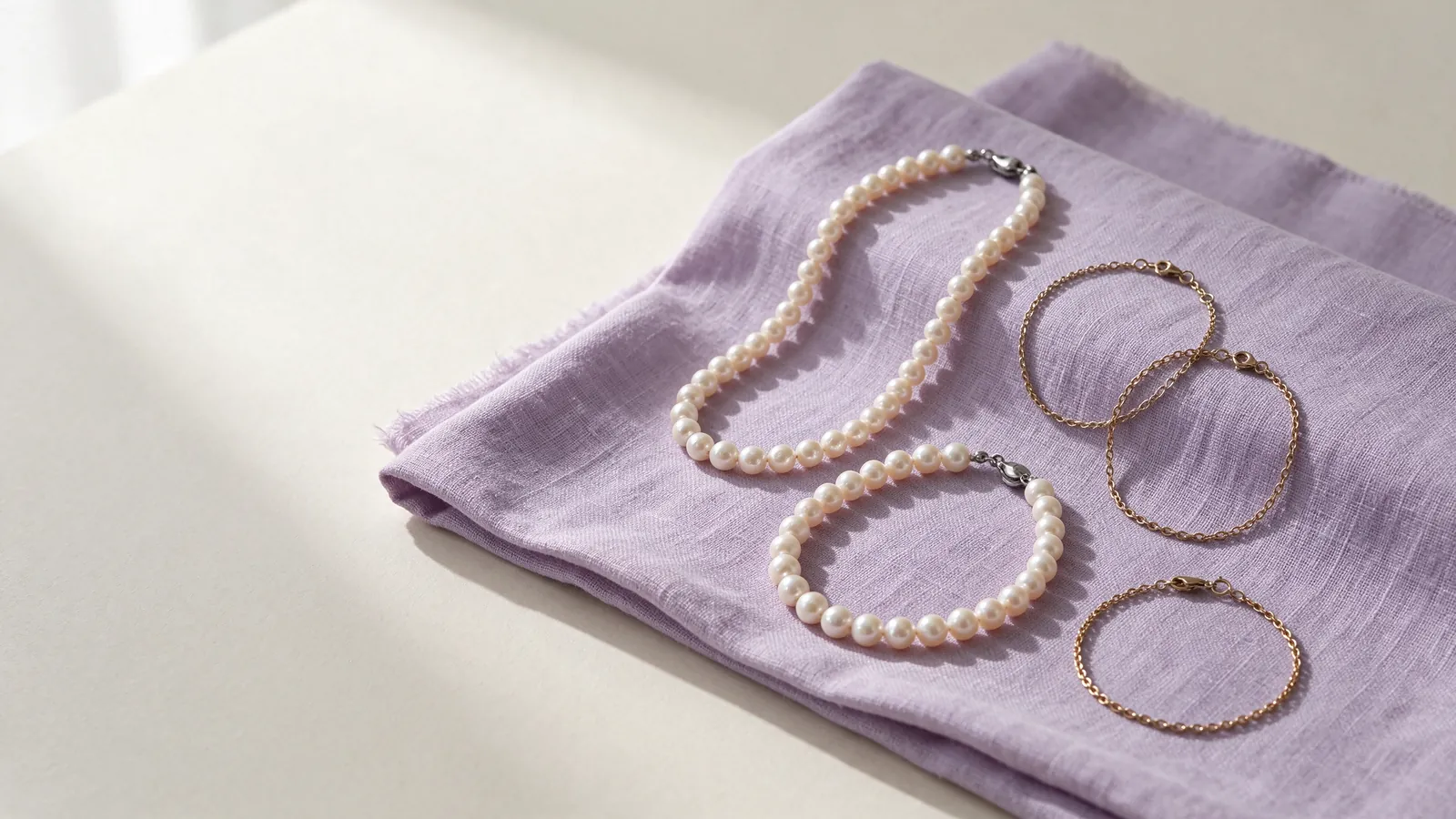
How should a white pearl bracelet, a white pearl chain bracelet or a white cultured pearl bracelet fit your wrist?
Measure your wrist at the intended wearing position with a soft tape resting against the skin, without pulling it tight. Record the position as well as the measurement: sitting above the wrist bone can feel different from sitting below it. When comparing a pearl bracelet, remember that its stated overall length does not directly describe the space inside a curved row of pearls.
Decide whether you prefer the row to remain close to the wrist or move a little with your hand. There is no single extra-length rule that replaces trying the construction on. Let your arm hang, bend your wrist and rest your hand on a desk. Notice whether the bracelet catches at the bone, reaches the palm or bunches inside your usual cuff.
When trying on a white pearl bracelet, a white pearl chain bracelet or a white cultured pearl bracelet, what should you check at the clasp?
Fasten it yourself using the hand you would normally use, then check that the closure lies comfortably rather than twisting against the skin. Move the clasp to the side and underside of the wrist while lifting a bag or putting on a sleeve. If it repeatedly travels to the front, compare the fit and distribution of the row instead of judging the clasp in isolation.
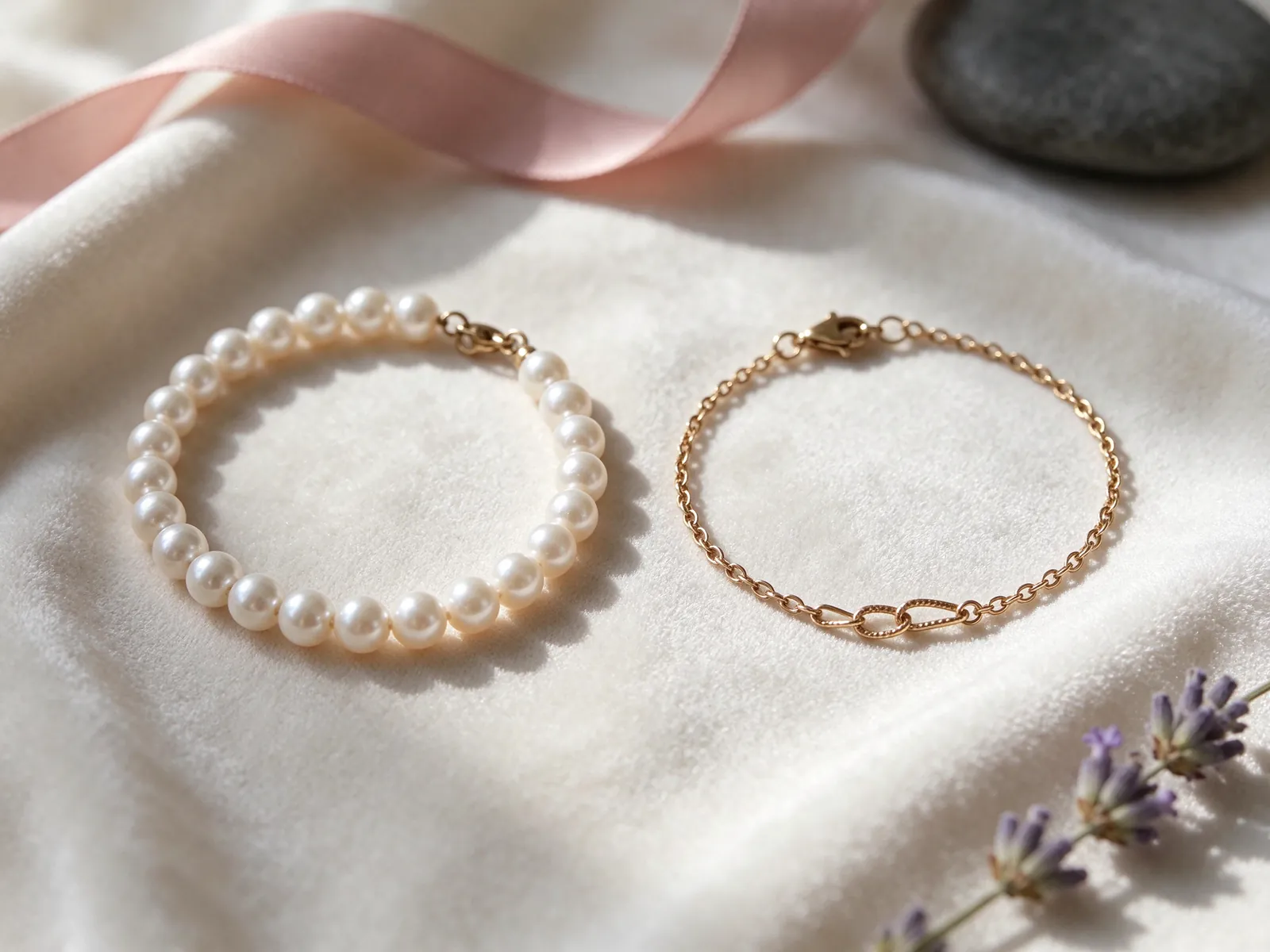
Reading white colour without confusing it with pearl identity
White describes colour, not a complete identity. It cannot by itself establish pearl type, origin, treatment or whether a pearl is natural or cultured. The phrase white cultured pearl bracelet adds a formation description, whereas white pearl chain bracelet adds construction information. Keeping those descriptions separate helps you ask useful questions rather than expecting one name to answer everything about a piece.
GIA distinguishes bodycolour, overtone and orient, and notes that not every pearl shows all three. Compare pieces under similar light before examining them on your own wrist. A pale reflection in a photograph should not become a claim about identity. If you are considering a pistachio green pearl bracelet as well, compare the colour effect you want with your clothes, not an assumed quality ranking between colours.
Should white pearls match a white shirt exactly?
Bring the shirt or a similar fabric into the comparison. Cloth and pearl surfaces reflect light differently, so an exact visual match is not the only successful result. Look for a clear outline beside the cuff and decide whether a gentle contrast feels right. Check in the lighting you commonly use rather than making the whole decision from a brightly lit screen.
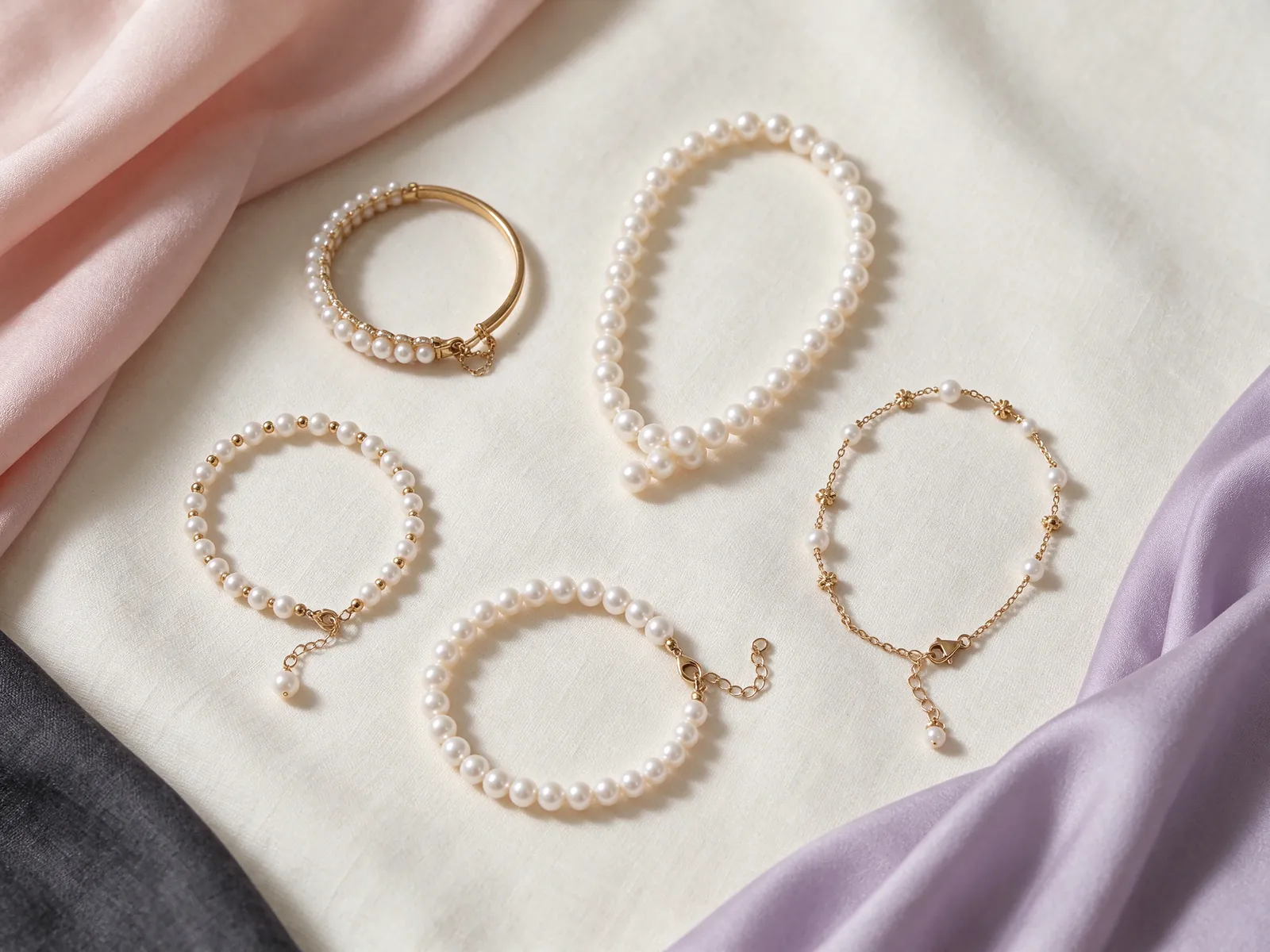
Comparing a continuous pearl row with a chain structure
A continuous row puts emphasis on the sequence of pearls; a chain structure can introduce visible space and metal lines between them. Look beyond the front view to see how far the pearl section extends around the wrist and where the connections sit. The important distinction is how that arrangement curves, moves and meets the clasp, not simply which construction name sounds more delicate.
For a lighter visual impression, compare the pearls with the width of your wrist and sleeve rather than assuming that smaller always means more comfortable. A small pearl bracelet can be a useful proportion reference. A fine row may make the clasp more prominent, while a spaced arrangement may move differently when you turn your palm. Examine both effects with the hand relaxed.
Where should you look for catching or concentrated movement?
Leave the chain in its natural position instead of pulling every link straight for inspection. Turn your palm and pass a sleeve over the wrist, watching raised connections and the area next to the clasp. For a strung row, look for awkward bunching; for a chain arrangement, notice whether the pearls gather on one side. Neither pearl count nor open space alone establishes durability.
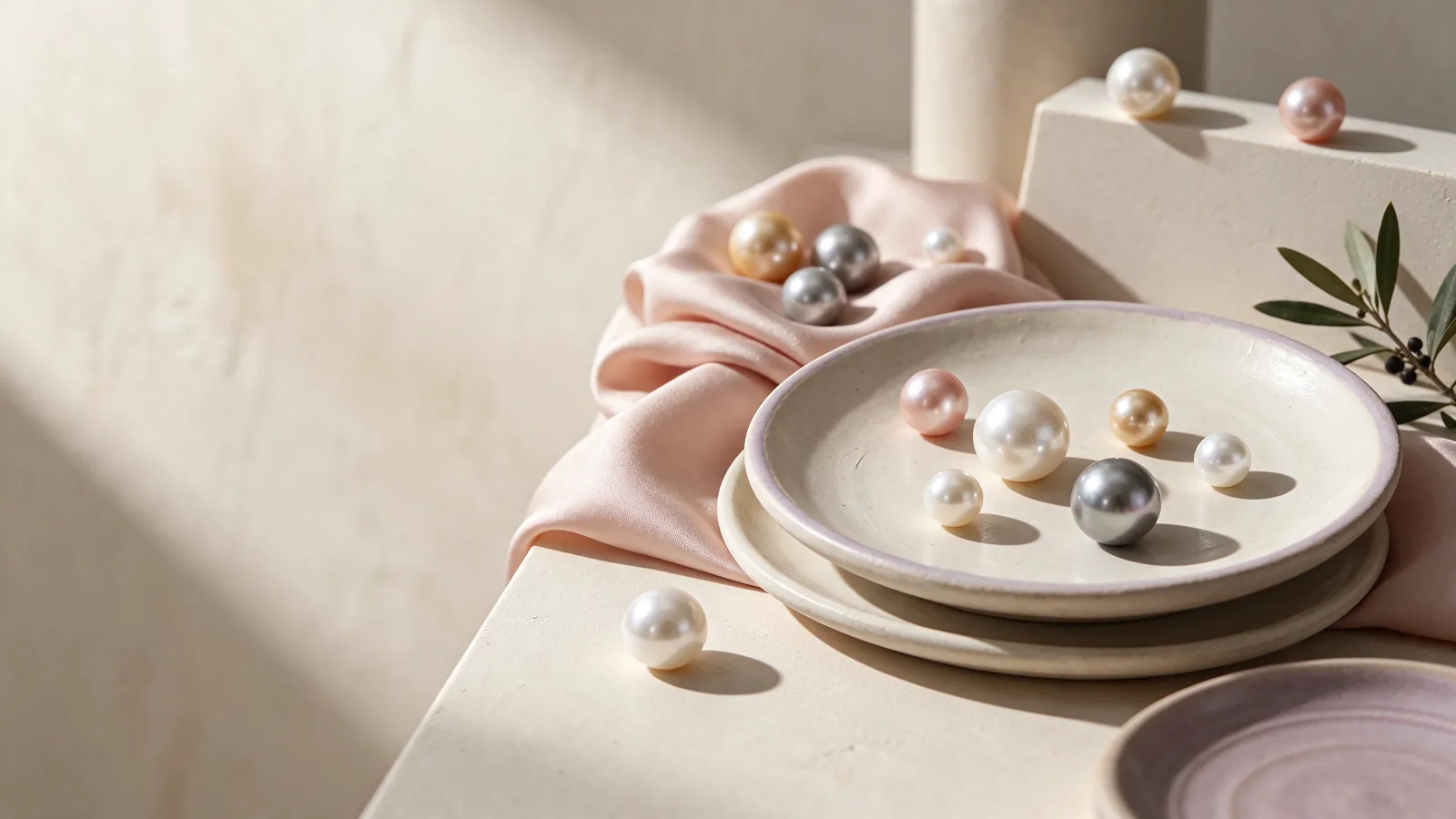
Matching a white pearl row involves more than roundness
GIA describes seven pearl quality factors: size, shape, colour, lustre, surface quality, nacre quality and matching. This is a practical framework for separating your observations. A white row can look uneven because of differing reflections even when its outlines are similar. Conversely, a row with varied shapes can still have a coherent visual rhythm. The framework is not a certificate for an individual bracelet.
If you enjoy an irregular silhouette, compare a baroque pearl bracelet for the way shape interacts with sleeves and other jewellery. Decide whether you prefer a regular outline or an intentionally varied one, then examine colour and lustre across the row. Shape alone does not establish origin or natural-versus-cultured identity, and a striking outline is not a reason to assume investment value.
How can you distinguish uneven lighting from uneven matching?
Lay the row on a consistent background and rotate it slowly. A pearl that appears dark from one angle may change as the light moves across it. Then assess the bracelet at a normal viewing distance on the wrist, including the underside. This separates a close-up detail from an overall impression and avoids treating a carefully arranged front photograph as the whole piece.
Choosing metal colour and understanding material descriptions
When discussing metal options, distinguish 18K 750 white gold, 18K 750 yellow gold, 18K 750 rose gold, PT950 platinum and PT900 platinum from the colour description of the pearls. Consider whether the metal line should blend into the white row or provide contrast. A metal's appearance does not identify the pearls, and a white pearl surface does not require a matching white metal.
If your search also includes sterling silver pearl bracelet, treat that as a separate material-comparison topic rather than another name for white pearls. Read the metal description, pearl description and closure details as distinct pieces of information. Once you know the visual effect you prefer, discussing the metal and clasp becomes more focused than combining colour, construction and expectations into one broad search phrase.
Should the clasp disappear visually or become a feature?
For a pearl-led look, check whether the clasp dominates the front or introduces a distracting reflection. For a feature closure, see whether it remains balanced when it turns to the side. In either case, access and comfortable contact come before styling. Try fastening it without assistance and observe whether the connection sits naturally once closed; a neat appearance does not replace a suitable working closure.
Styling white pearls for work, occasions and other jewellery
For office wear, start with the cuff rather than the colour alone. The bracelet should sit as you prefer when the sleeve moves, without repeatedly being pushed towards the palm. For an occasion outfit, examine embroidered edges, sequins or stiff fabric near the wrist. Compare the pearl row's visual weight with those details and check which surfaces might contact it during ordinary movement.
When adding a watch or another bracelet, decide whether you want parallel lines or one clear focal point. Rest the wrist on a desk and rotate it gently to observe contact between the pearls and hard edges. If the pieces repeatedly knock together, wearing them on separate wrists may suit you better than tightening the pearl bracelet to hold every item in place.
Does a bracelet need to duplicate your white pearl earrings?
A coordinated impression can come from compatible colour and lustre without identical shapes or dimensions. Earrings sit against the face, while a bracelet is viewed beside the sleeve; their backgrounds differ. Try both with a familiar outfit and notice which piece draws attention first. You can keep the common white impression while allowing different silhouettes room to work, rather than demanding an exact visual copy.
Caring for the pearl surface, string and clasp after wear
A bracelet encounters desks, sleeves and personal-care products during ordinary hand movements. Finish applying perfume and hair products before putting it on, and wipe it after wearing with a very soft, clean cloth. GIA gives pearl a Mohs hardness of 2.5, making gentle handling relevant. Store it apart from jewellery with hard edges rather than crowding everything into a small compartment.
Do not assume that a cleaning method suitable for your other jewellery is suitable for pearls. GIA says pearls should never be cleaned with ultrasonic or steam cleaners, and advises avoiding acids, perfume, hair spray and excessive heat. Consider the bracelet's actual construction before cleaning, particularly whether a string is involved, and avoid pulling on the row while wiping around the clasp or connections.
When can a strung bracelet be worn after water cleaning?
GIA advises that the string must be completely dry before wearing pearls that have been strung and cleaned with water. A dry-looking pearl surface does not establish that the string is dry, so a fixed waiting time is not a substitute. Before wearing again, notice fraying, unusual looseness or a closure that no longer works smoothly, and seek suitable advice rather than continuing to pull at it.
Would you like to bring your preferred white pearl look together with everyday wearing habits? Contact Flint Jewellery on WhatsApp or call +85260106207 to discuss wrist measurement, cuff styling, clasp access and the movement you prefer.
| Aspect | What to observe | Styling question | Try-on check | What it does not establish |
|---|---|---|---|---|
| Wrist fit | Inside space and where the row moves | Does it work with your usual cuff? | Bend the wrist and rest the hand on a desk | Overall length is not the same as inner wearing space |
| White colour and lustre | Base colour and reflections under similar light | Does the row retain its outline beside your fabric? | Change the background, then wear it | White does not identify type or formation |
| Row or chain structure | Spacing, continuity and connection positions | Is the visual weight right for the wrist? | Turn the palm and inspect the underside | A name does not describe every structural detail |
| Shape and matching | Coherence of colour, reflections and outline | Regular lines or varied rhythm? | Lay the row flat and rotate it slowly | Shape is not proof of origin or certification |
| Clasp and care | Closure access, contact and string condition | Does it catch a sleeve or touch a watch? | Fasten it yourself and mimic daily movement | Appearance does not replace construction and care needs |
Pearl knowledge and authoritative references
GIA gives pearl a Mohs hardness of 2.5. This is relevant to gentle bracelet care, not a durability guarantee or a quality grade.
Read the reference for this factFrequently asked questions
Does white cultured pearl bracelet mean the same thing as white pearl chain bracelet?
No. Cultured refers to how a pearl forms, while chain describes construction. White describes colour. These terms can address separate aspects of a description, but one does not prove the others. Read the pearl identity and structure details individually rather than using a search phrase as a complete specification.
Should I add the same amount to my wrist measurement for every design?
No single allowance works as a substitute for trying different structures. Pearl shape, the depth of the row, chain links and the clasp can affect usable inside space. Compare how the bracelet behaves with the arm relaxed, the wrist bent and the hand resting on a desk, then choose the movement you prefer.
Can I judge white colour accurately from two separate product photographs?
Different lighting, backgrounds and screen settings can change the impression. Compare under similar light where possible, then look beside your own sleeve and on your wrist. GIA separates bodycolour, overtone and orient; a reflection in a photograph should not be treated as proof of a pearl's identity or treatment status.
Must the clasp stay hidden underneath the wrist?
Not necessarily; a clasp can be visually quiet or part of the styling. What matters is that it is accessible, closes suitably and feels comfortable as the wrist moves. If it constantly rotates to an unwanted position, reassess the fit and arrangement instead of repeatedly pushing it back without considering the cause.
Is a dry pearl surface enough after cleaning a strung bracelet with water?
No. GIA advises that the string must be completely dry before the pearls are worn again. The visible surface does not establish the condition of the string. Avoid a universal waiting-time rule, and do not use ultrasonic or steam cleaners for pearls. Routine after-wear care uses a very soft, clean cloth.
Updated: