
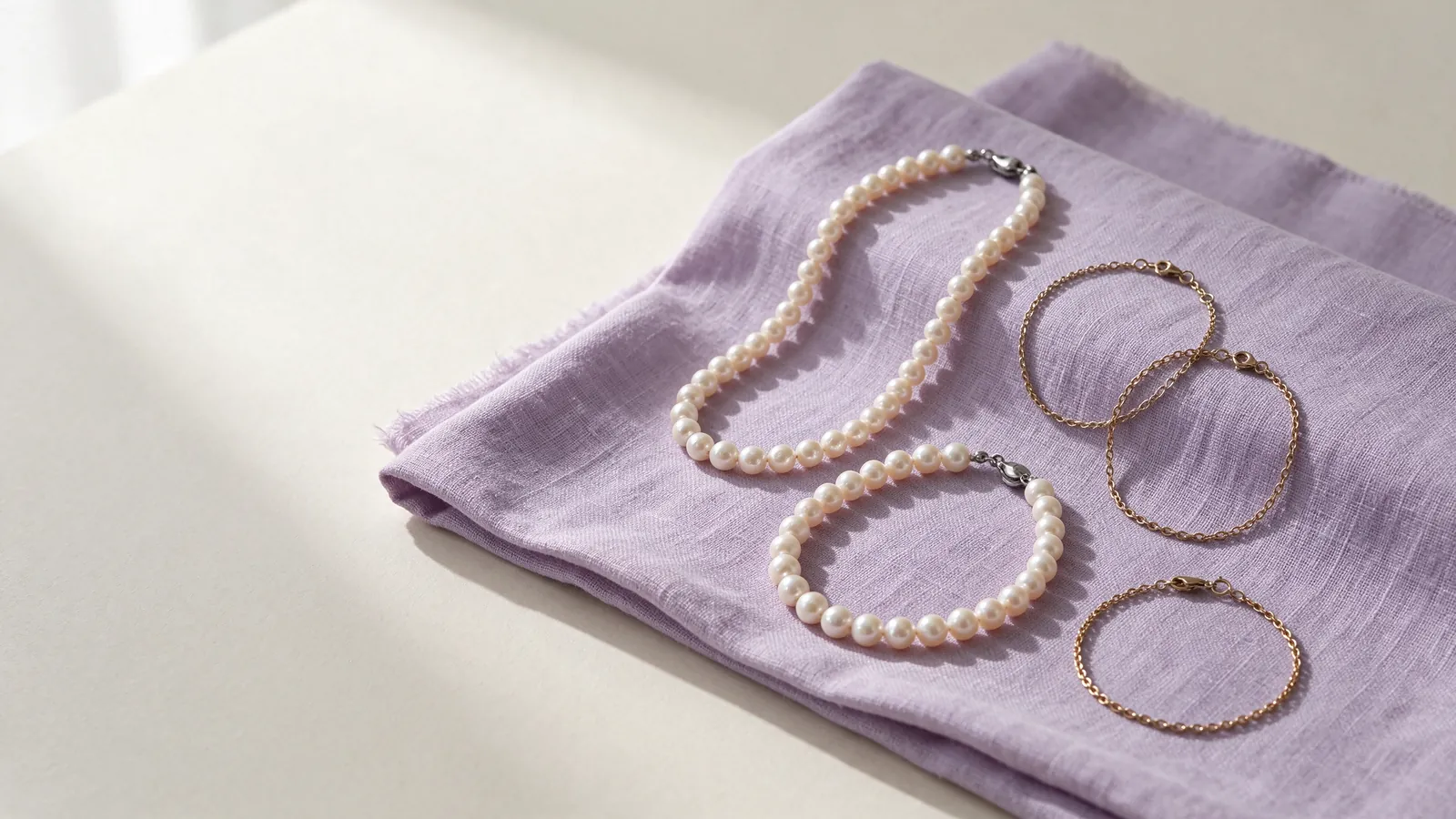
How should a Japanese Akoya pearl bracelet or an Akoya cultured pearl bracelet fit your wrist?
Start with a soft measuring tape resting against the part of your wrist where you normally wear a bracelet. Keep it level and do not compress the skin. Record this close wrist measurement separately from your preferred fit: close to the wrist, gently mobile, or lower towards the hand. A bracelet's total length does not directly describe the usable space inside it, because pearl thickness, connections and the clasp all affect that space.
When comparing a pearl bracelet, consider how it behaves while you work, not only how it hangs with your arm relaxed. A close fit may feel different when the wrist bends, while a loose strand may slide towards the palm or turn its clasp onto the desk. Ask whether a stated measurement means end-to-end length or internal circumference. There is no single addition to a wrist measurement that guarantees every bracelet structure will fit identically.
When trying on a Japanese Akoya pearl bracelet or an Akoya cultured pearl bracelet, how do clasp position and wrist movement affect comfort?
Position the clasp at the side of the wrist, then gently turn your hand, open your palm and imitate typing or holding a cup. Notice pressure against the wrist bone, pulling between pearls and repeated contact with the tabletop. Comfortable movement does not mean the bracelet must remain motionless. It means the design moves without obvious pinching or catching, and you can confirm that the clasp is properly closed rather than relying on a sound alone.
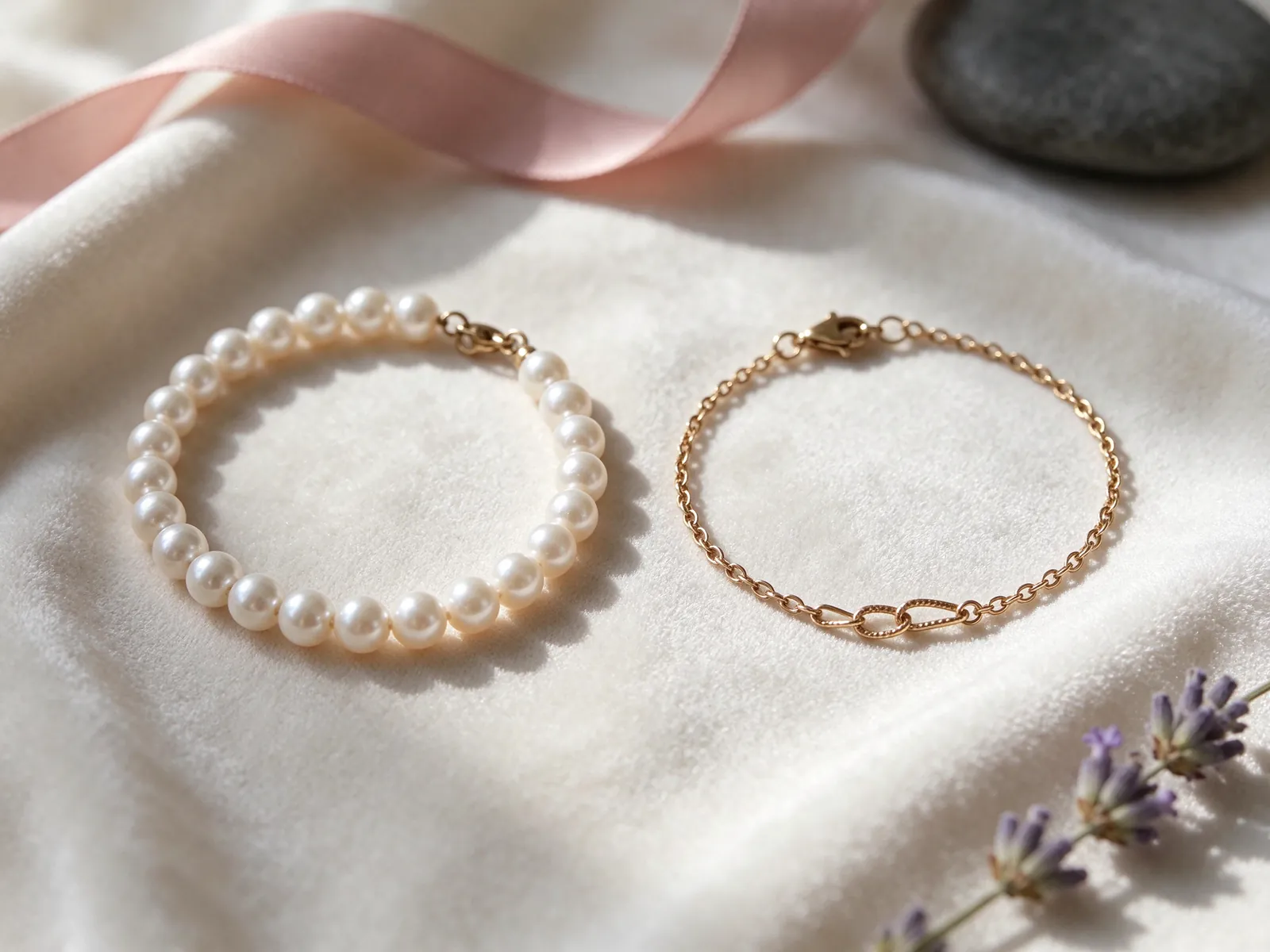
Read pearl type, formation and origin as separate details
Akoya names a pearl type. Cultured describes formation involving human intervention, while Japanese concerns origin. These terms answer different questions: an organic formation process does not by itself establish a wild-natural pearl, and a Japanese name does not establish where a particular pearl was grown. A Japanese Akoya pearl bracelet description therefore deserves a closer reading than a familiar phrase might suggest. White colour and a round appearance cannot resolve these questions either.
The guide to what are Akoya pearls provides a starting point for understanding the terminology. When returning to a bracelet description, distinguish the place where pearls were cultured from where they were processed or where the jewellery was assembled. Ask what the origin wording actually refers to. Information about a different necklace or a shop's location cannot automatically describe the bracelet you are considering, even if the photographs look similar.
Ask questions that identify the particular bracelet
Instead of asking only whether the pearls are Japanese, ask how the pearl type is described, whether the pearls are cultured, and which production stage the origin statement covers. Colour treatment information is another separate question. If documents accompany the piece, read what they identify rather than assuming they certify every aspect of the strand. This approach makes descriptions comparable without turning a marketing adjective into a complete quality judgement.
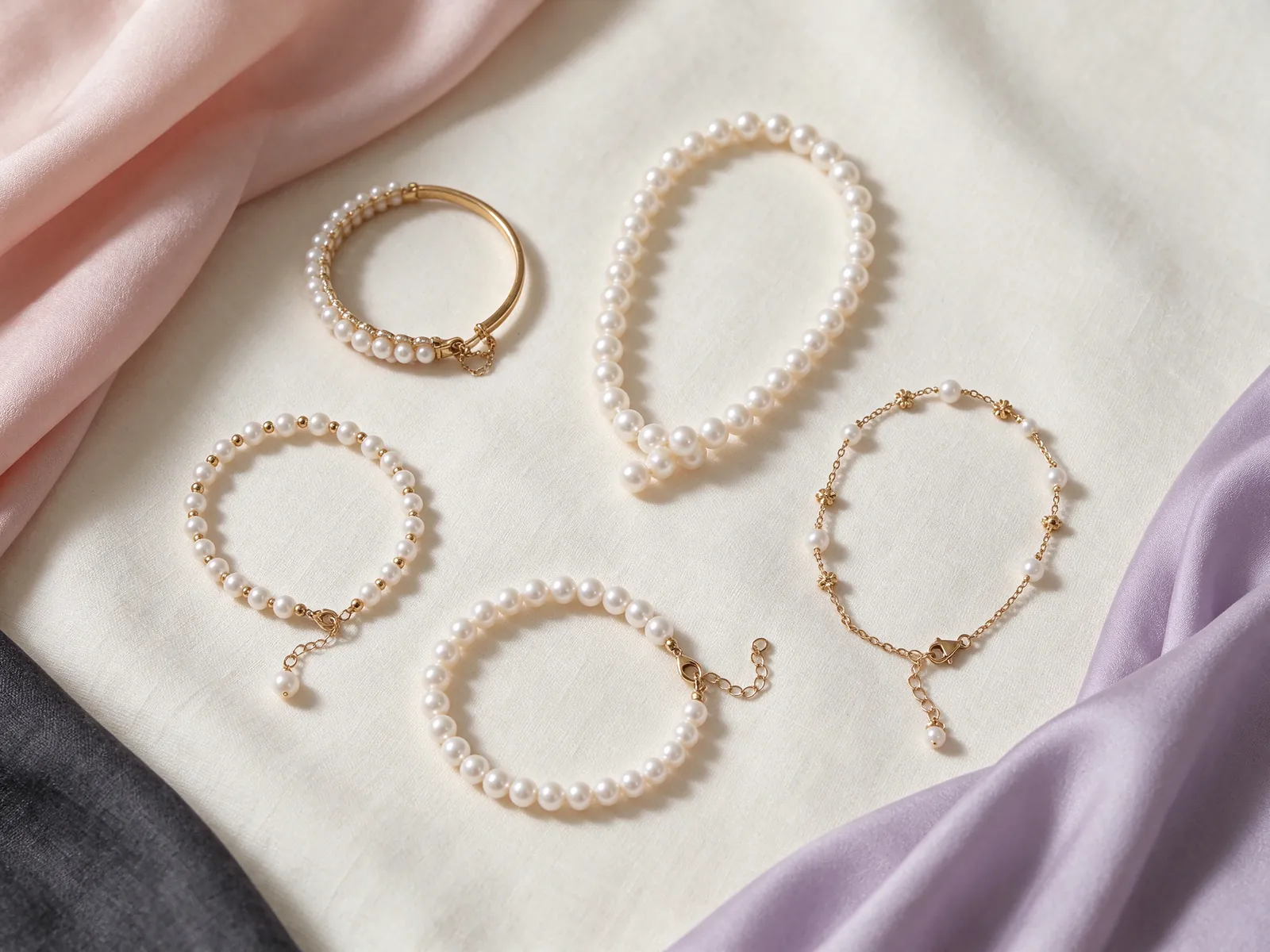
Assess the whole strand rather than its brightest pearl
A bracelet turns with the wrist, so different pearls enter view throughout the day. Look first at the overall harmony, then at individual lustre, shape and surface characteristics. GIA describes seven pearl value factors: size, shape, colour, lustre, surface quality, nacre quality and matching. These factors help organise your observations, but they do not mean every factor can be determined from a photograph. In particular, an attractive reflection does not measure nacre quality.
Use consistent, gentle lighting when comparing strands. Look at the definition of reflections and the relationship between neighbouring pearls rather than comparing a heavily lit image with a shaded one. If a freshwater pearl bracelet is another option, record the visual effect you prefer separately from pearl identity. A preference for a rounded outline or a soft colour is useful for selection, but neither feature alone identifies the pearl type.
Use colour to define the styling goal
A pale strand can be considered against your skin and usual sleeve colours; a darker strand may create a more distinct accent. The black Akoya pearl bracelet guide explores that different colour direction. A dark colour name does not establish a shared natural colour origin or remove the need to understand treatment information. In either direction, consider the complete strand before treating lightness or darkness as a simple ranking of quality.
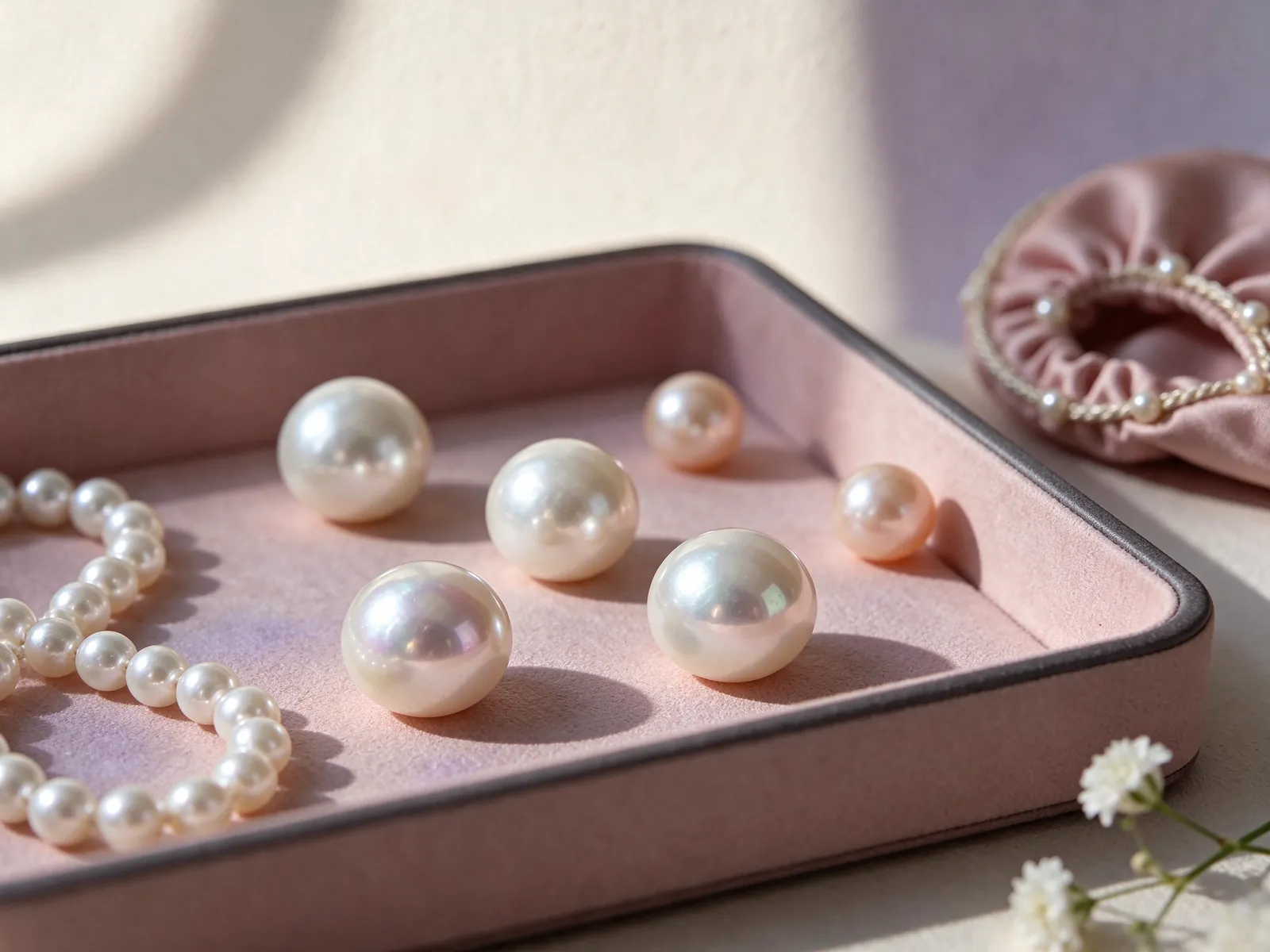
Choose a silhouette that works with sleeves and other jewellery
An uninterrupted strand creates a continuous outline, whereas pearls separated by metal sections leave more visible space and a different rhythm. These are structural choices, not rules requiring a particular pearl type. Think about whether you want a defined band of pearls or smaller accents around the wrist. Then look at how the pearl volume, connections and clasp work together rather than deciding that a fuller outline is automatically more formal.
Try the bracelet with the sleeves you actually wear. A thick cuff can push it towards the hand, and a textured fabric may catch a projecting clasp. Short sleeves reveal more of the silhouette, while a narrow cuff may hide much of it. For another shape-led approach, a baroque pearl bracelet offers a useful comparison. An irregular outline and a rounded outline create different effects; shape alone does not establish overall pearl quality.
Check watch contact before choosing a stack
Wearing a watch and pearl bracelet on opposite wrists reduces opportunities for direct contact between them. If you prefer the same wrist, observe whether the watch case or clasp repeatedly rubs a pearl as you move. A photograph of a jewellery stack cannot reveal that interaction. Test the combined arrangement while sitting and reaching, and consider wearing only one piece for activities that bring the wrist into regular contact with hard surfaces.
Evaluate clasp access, position and the path of tension
A clasp affects whether you can put the bracelet on comfortably by yourself. When reading about a pearl bracelet clasp, consider finger access, how clearly you can see the opening, and whether fabric can become trapped during closure. A small clasp is not automatically unsuitable, and a large clasp is not automatically comfortable. Operation, placement and the surrounding connections matter together; appearance cannot establish how the closure will behave on your wrist.
A more prominent clasp may rotate downwards, but rotation also depends on the strand's overall weight distribution and looseness. If you want the clasp to be visible, see whether it naturally settles where you like it rather than tightening the bracelet to hold it there. Where an extension is present, check whether its end reaches the desk or catches a sleeve. Added length and usable internal space are related, but they are not interchangeable measurements.
Test ordinary handling, not a forceful pull
Try opening and closing the bracelet with the hand you would normally use. Notice whether you must rely on a fingernail or an awkward wrist position. Do not pull hard on the closure to test security, because tension may travel into the string or connecting parts. If a clasp becomes difficult to close or a connection appears loose, pause wearing it and understand the issue rather than repeatedly forcing it into place.

Let the metal colour support the pearl composition
For an 18k gold pearl bracelet, the metal directions to consider are 18K 750 white gold, 18K 750 yellow gold and 18K 750 rose gold. A platinum pearl bracelet introduces PT950 platinum or PT900 platinum as metal descriptions. These labels concern metal selection, not pearl type, origin, treatment or quality. Keep the two sets of information separate when comparing a description, rather than allowing a preferred metal to answer questions about the pearls.
Compare the colour relationship against familiar clothing rather than following a universal rule about skin tone. Cream, pink or grey sleeves may emphasise a softer composition, while a dark sleeve can make the outline more distinct. If you already wear a ring, consider the visual balance between the two pieces and whether they touch during movement. Matching every metal colour is less useful than finding a bracelet that feels right in your normal routine.
Look beyond the front view of metal details
Small spacers create rhythm, while a more visible clasp can become a separate focal point. Examine the sides of the wrist as well as the front, noting projecting connections near the skin or sleeve. The amount of metal is not a pearl quality grade. When considering a budget, separate your priorities for the pearls, the structure and the styling effect so that an attractive detail does not obscure a practical concern.
Decide whether pearl care fits your everyday routine
GIA places pearl at 2.5 on the Mohs hardness scale. A bracelet is frequently near desks, watch cases and other jewellery, making repeated rubbing an important practical concern. The number is not a lifespan prediction or a guarantee against impact. Put pearl jewellery on after applying perfume, hair spray and skincare, avoid acids and excessive heat, and remove the bracelet for chores or activities involving frequent water contact rather than treating it as an all-purpose accessory.
After wearing, gently wipe the pearls with a very soft, clean cloth and store them separately from hard jewellery. GIA states that pearls should never be cleaned with ultrasonic or steam cleaners. If a strung piece is cleaned with water, its string must be completely dry before it is worn again. While handling it, look for changes near knots, drill holes and clasp connections; an observation of possible wear is a reason to understand the structure, not to improvise a repair.
Bring the final choice back to your actual day
Before choosing, bring together your close wrist measurement, preferred movement, common sleeve types, watch habits and ability to operate the clasp. If you dislike removing jewellery, consider whether the contact and cleaning needs of pearls suit that preference. A satisfying choice combines a clear understanding of the description, a strand you enjoy looking at and comfort during real movements. None of those decisions is replaced by a single prestige term. Contact Flint Jewellery on WhatsApp or call +85260106207 to discuss your wrist measurement, usual sleeves and clasp preferences.
| Decision | What to examine | Practical check | Misreading to avoid |
|---|---|---|---|
| Wrist fit | Close measurement, pearl thickness and clasp space | Compare a straight and gently bent wrist | Total length equals internal circumference |
| Identity and origin | Pearl type, cultured identity and the origin statement | Ask what each term describes | A Japanese name proves Japanese origin |
| Matching | Lustre, shape and colour across neighbouring pearls | Turn the strand under consistent light | The brightest pearl represents the whole strand |
| Clasp and sleeves | Finger access, position and any extension | Close it yourself with a usual cuff | A larger clasp is always more comfortable |
| Daily contact | Desks, watches and cleaning products | Imitate typing and holding a cup | A durable metal makes pearls scratch-resistant |
Pearl knowledge and authoritative references
GIA lists pearl at 2.5 on the Mohs hardness scale. For a wrist piece, this supports careful handling around hard surfaces; GIA also advises against ultrasonic and steam cleaning.
Read the reference for this factFrequently asked questions
Does cultured mean that an Akoya pearl is an imitation?
No. Cultured describes formation involving human intervention; it is not the same description as an imitation. It also does not, by itself, tell you the pearl type, origin, treatment or quality, so read those details separately.
Can a bracelet's listed length be compared directly with my wrist measurement?
It is a starting point, not a complete fit assessment. Find out whether the listed length is measured end to end or inside the closed bracelet. Pearl thickness and clasp structure can change the space available around the wrist.
Why does the clasp keep moving to the underside of my wrist?
The movement can reflect weight distribution, fit and wrist activity. Check how it settles during ordinary use. Tightening the bracelet merely to keep a clasp visible may compromise comfort and does not necessarily solve the rotation.
Must all the pearls look identical for the bracelet to be attractive?
No. Matching should support the intended composition, and a controlled variation may be part of the effect you enjoy. Compare the entire strand in consistent light and distinguish your styling preference from questions about pearl identity or quality.
Can I leave the bracelet on when applying perfume?
It is better to apply perfume before putting pearl jewellery on and to avoid direct contact with the pearls. GIA includes perfume and hair spray among substances to avoid. This is especially relevant to a wrist piece used close to hands and sleeves.
Updated: