
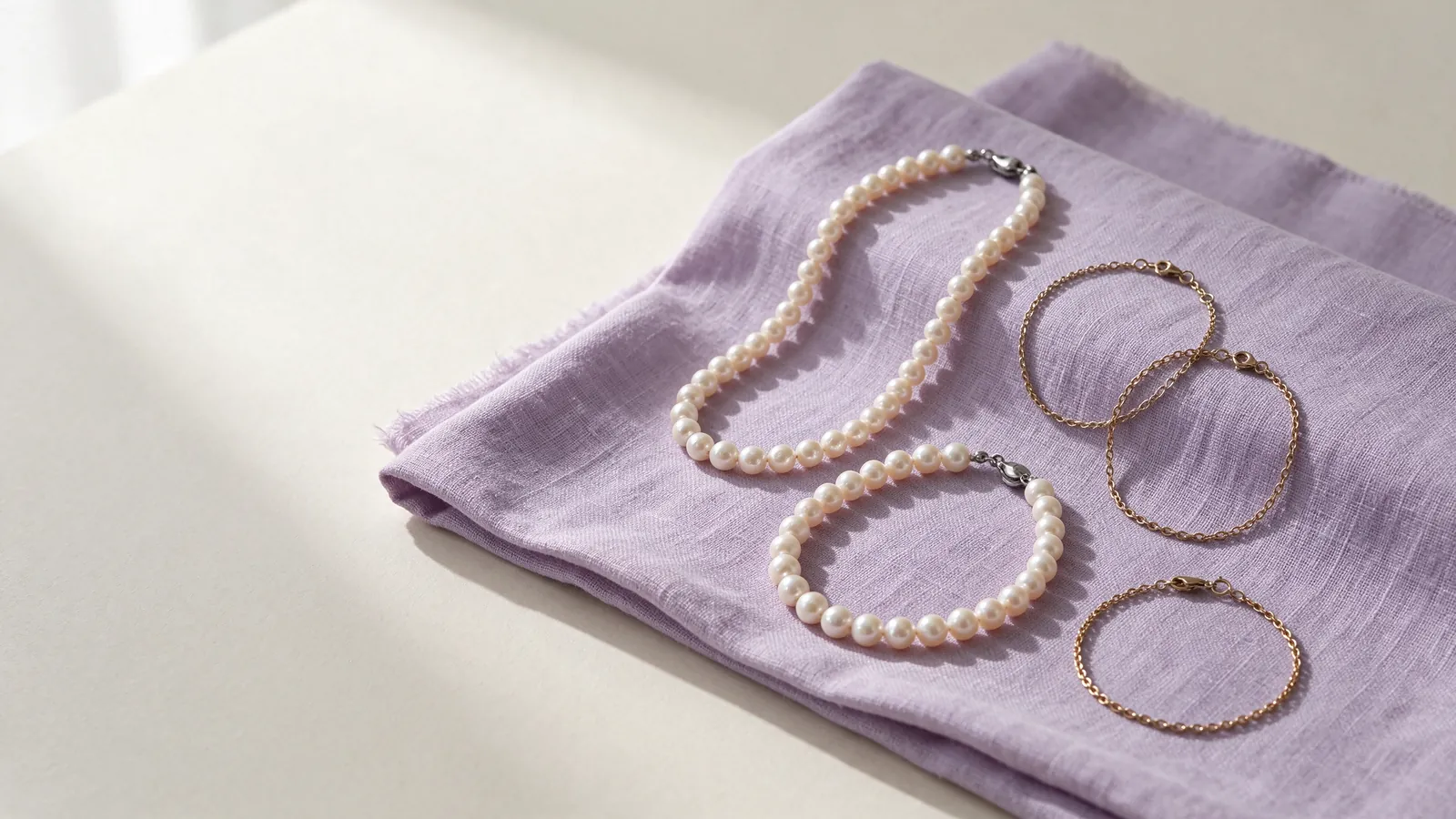
How does flower pearl bracelet scale affect pearl flower bracelet detail and floral pearl bracelet styling?
A flower pearl bracelet can read as a single focal point or as a lighter botanical accent. The difference depends on the outline, the space between petals and the contrast between the motif and its chain, not simply on the flower's overall size. When comparing a pearl bracelet, start with its whole silhouette at the wrist before moving closer to examine the flower. A detailed close-up can make a modest motif appear much more prominent than it feels when worn.
For a pearl flower bracelet, consider whether the petals remain recognisable when part of the motif sits beside a cuff. Open spaces can make the design feel less dense, while a closely gathered arrangement draws attention to a compact area. A floral pearl bracelet does not need the most elaborate outline to suit you. Decide whether you want a flower that is immediately visible or a quieter detail that becomes apparent as you move your hand.
From flower pearl bracelet proportions to pearl flower bracelet fit: wearing a floral pearl bracelet comfortably
During a fitting, lower your arm naturally, rest your forearm on a table and then turn your wrist gently. Notice whether the flower moves underneath the wrist, presses against the skin or pulls the chain taut. Space for movement must accommodate both the wrist and the motif's profile. A familiar finger-space test alone cannot tell you whether a projecting flower will remain comfortable or whether its connection allows it to turn over repeatedly.
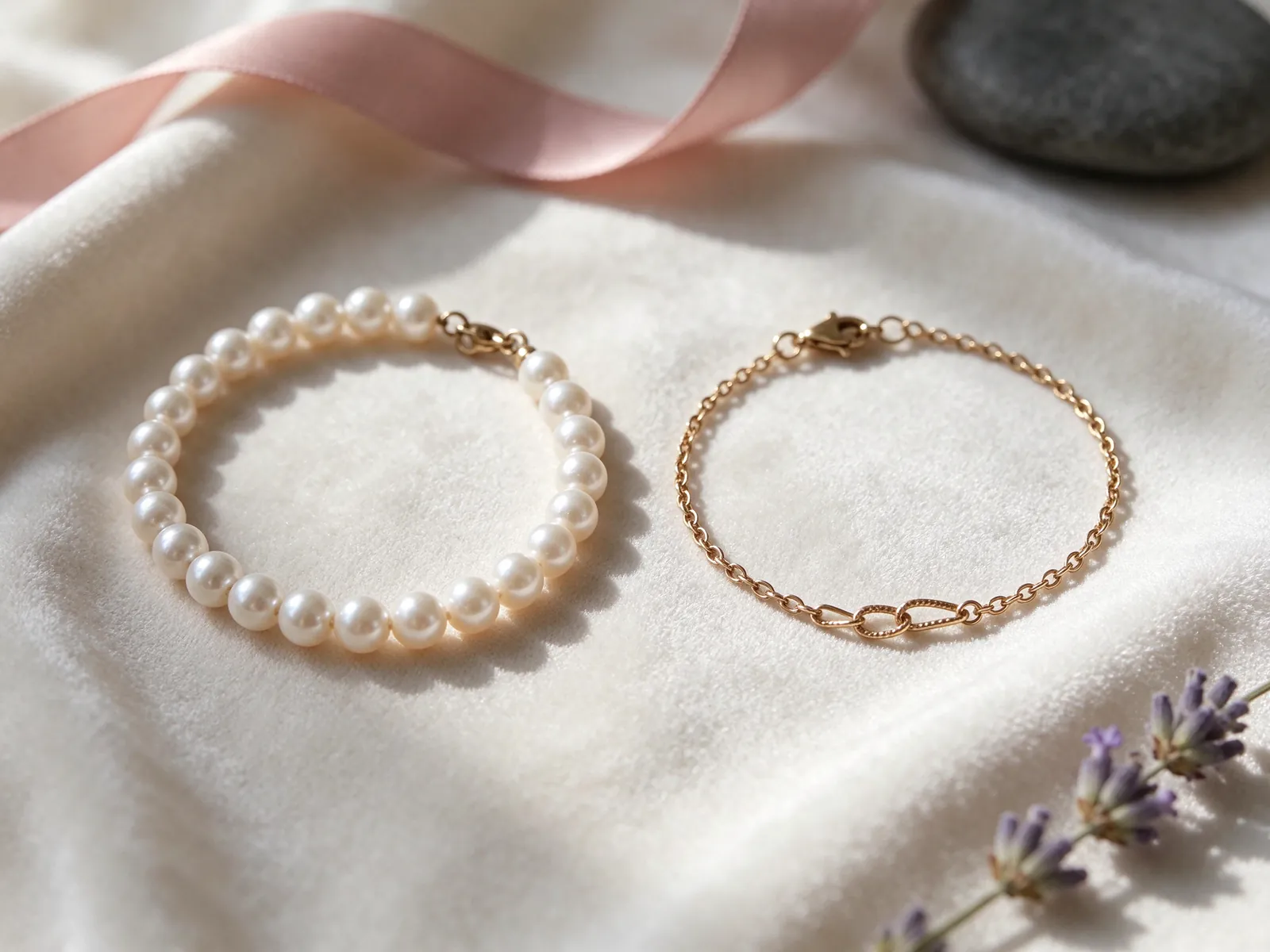
Measure the wearing position, not just a familiar chain
Place a flexible tape around the wrist where you intend to wear the bracelet, keeping it close without pulling it tight. Record that position as well as the measurement. Your wrist circumference and a bracelet's full length are different pieces of information. The pearl bracelet size guide helps explain why a clasp, a floral centrepiece and a flexible chain must be considered together, rather than copying the length of a fine chain with a different construction.
Bring a shirt or jacket that you wear often to a fitting. A cuff can push the flower towards the hand or hold it against the wrist, changing how the bracelet sits. If you type regularly, check the resting position on a desk; if you wear buttoned cuffs, close them before judging the available space. Look at the bracelet while seated as well as standing, because the motif's resting point can change with the direction of your arm.
Treat adjustment and motif stability as separate questions
An adjustable pearl bracelet may offer different wearing positions, but extra length choices do not automatically keep a flower facing upwards. At each usable setting, observe the motif's rotation, the position of any trailing chain and how easily you can operate the adjustment. Choose a setting that works with ordinary movements rather than assuming the tightest position is the best. If the flower still turns underneath, its balance and connection deserve attention too.
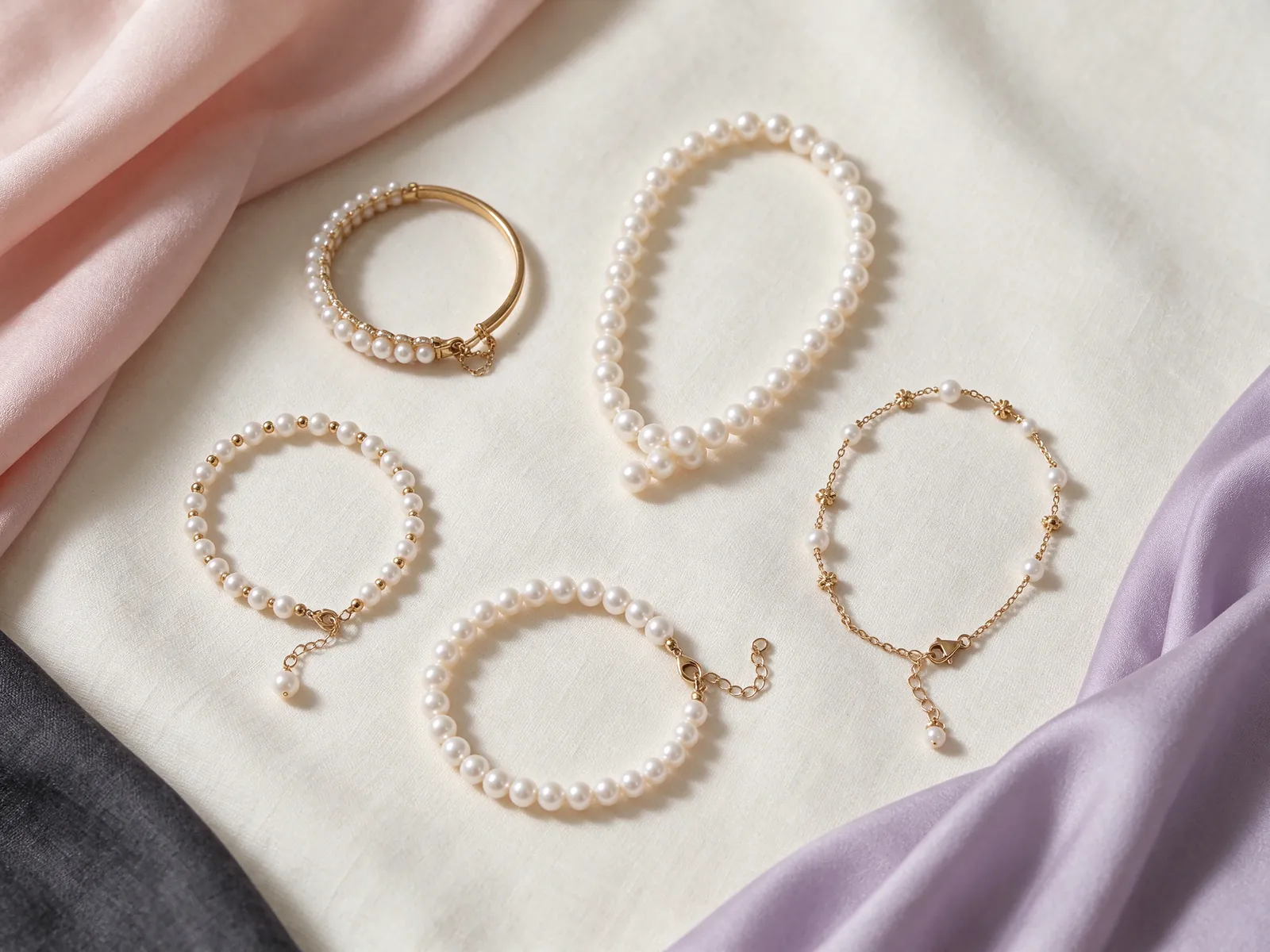
Separate the flower's composition from pearl quality
A floral effect might come from pearls arranged around a centre, or from a pearl framed by a petal-shaped outline. These describe composition, not pearl species, origin or natural-versus-cultured identity. Read the pearl description separately from the design name. A photograph of a flower cannot establish those characteristics, and a similar motif in earrings does not supply the specifications of a bracelet. Keep what the jewellery looks like distinct from what its written description actually says.
GIA identifies seven pearl quality factors: size, shape, colour, lustre, surface quality, nacre quality and matching. Matching is particularly useful when looking at a flower made with several pearls. Consider how neighbouring pearls work together in colour, shape and reflections, rather than judging the entire arrangement by its brightest pearl. Matching does not demand an identical appearance in every petal; deliberate variation can still form a coherent design when the arrangement is visually balanced.
Observe the whole flower in gentle light
Turn the bracelet slowly under soft light and compare the complete motif before inspecting individual surfaces. Shadows may result from the arrangement or viewing angle rather than from a pearl's colour. A closer view helps with visible surface details; a more distant view helps with proportion. Lighting, backgrounds and screens can alter a photograph, so brightness in an image should not be treated as proof of nacre thickness or a particular pearl grade.
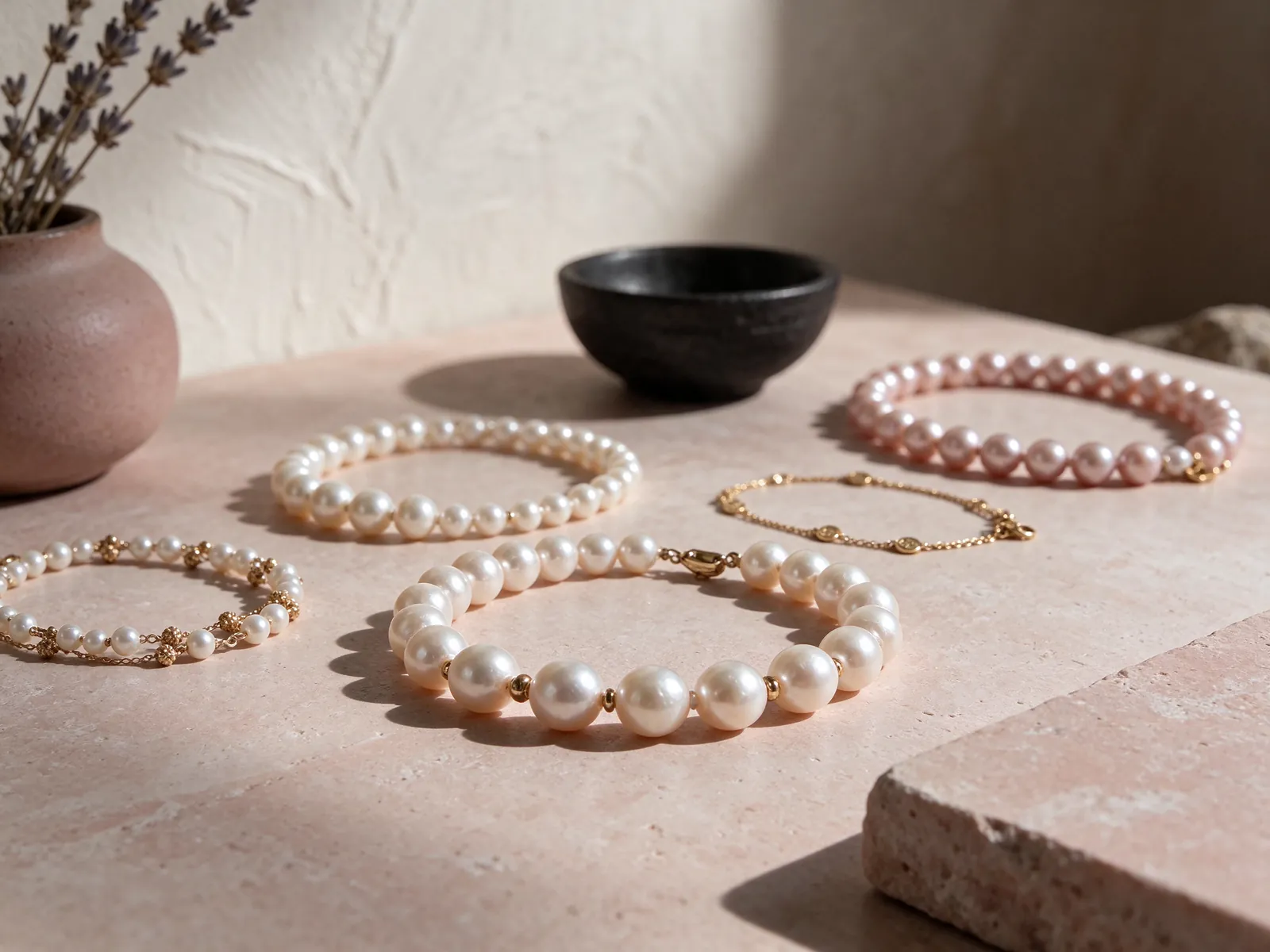
Style the motif around cuffs, knitwear and occasion clothes
With a shirt, the flower can provide a clear accent near the cuff without needing other wrist decoration. Check that the cuff edge does not catch a petal or repeatedly push the motif out of position. Loose knitwear needs a different test: look at projecting edges and connections that might meet knitted loops during normal dressing. Do not press fabric into the jewellery to test it; simply observe how the sleeve passes over the bracelet.
For short sleeves or evening clothes, the exposed wrist gives the floral outline more visual space. If your outfit already includes a floral print, a simpler bracelet silhouette can avoid competing details. Consider the colour of your usual rings or watch alongside the clothing, then decide whether you prefer harmony or contrast. Coordinating jewellery does not require every piece to share the same outline, and a flower motif need not be reserved for a formal occasion.
Check contact before planning a wrist stack
Before wearing the bracelet beside a watch or another bracelet, see whether the pieces repeatedly slide into one another. Pay particular attention to petals meeting a watch case or being trapped between neighbouring pieces. Wearing them on opposite wrists can retain the styling relationship while reducing direct contact. If you prefer the same wrist, test lowering your arm and picking up a bag, not only the still pose that looks attractive in a mirror.
Understand fixed flowers, moving charms and clasp handling
A flower held along the chain behaves differently from a hanging floral charm. The fixed version calls for attention to its angle against the wrist; a moving version calls for attention to its swing and contact with nearby surfaces. Reading about a pearl charm bracelet can help you recognise these structural questions, but not every floral motif is detachable. Judge the actual connection and avoid assuming that a decorative flower can be removed or rearranged.
Practise fastening with the hand you normally use for jewellery. You should be able to understand the closure, hold the working parts and notice whether the chain has twisted after fastening. Choosing a pearl bracelet clasp involves more than its appearance, particularly when a flower creates a noticeable centre of weight. If fastening requires you to pull on the petals for leverage, reconsider the handling method rather than making the decorative part carry that force.
Inspect the profile without bending the decoration
Look beneath the flower as well as across its face. Notice whether the back rests smoothly, whether an edge presses into the skin and how the motif sits beside the wrist bone when it rotates. Put it on and remove it gently; pulling connections with a fingernail is not a suitable strength test. Stop wearing it if a part becomes loose or an edge causes uncomfortable scraping, and have a jewellery professional inspect it instead of bending a petal yourself.
Compare floral emphasis with hearts and spaced pearls
If you are choosing between a flower and a heart pearl bracelet, compare the visual message rather than assigning either motif to an age group. A flower depends on petals, layers and open space; a heart centres attention on a readily recognised symbol. Both can work with everyday clothing. Compare them at similar wearing positions and with similar sleeves, so that romantic photography or a different background does not stand in for a genuine design difference.
A pearl station bracelet offers a useful contrast if you prefer the eye to move around the wrist rather than settle on one flower. Its spacing creates a distributed rhythm, whereas a floral motif asks you to judge the clarity of a local outline. Neither approach is inherently better. Think about whether you enjoy seeing a distinct motif while working or talking, or whether a series of quieter accents feels more natural with your clothes.
Do not confuse a motif with the bracelet's construction
A half chain pearl bracelet describes the distribution of pearl and chain sections, while a flower describes a decorative outline. Compare construction first, then ask whether you like the floral detail, and finish by checking fit. This prevents an appealing motif name from distracting you from the flexible and less flexible parts of the bracelet. It also explains why two bracelets with different structures may not feel alike simply because their stated full lengths match.

Care for petal details and choose gifts around real habits
Small spaces between petals may tempt you to use a stiff brush, but pearls call for gentle care. GIA places pearl at 2.5 on the Mohs hardness scale and says pearls should never be cleaned with ultrasonic or steam cleaners. After wearing, lightly wipe accessible surfaces with a very soft, clean cloth. Avoid perfume, hair spray, acids and excessive heat, and do not push tools between pearls and the surrounding decoration to remove trapped dirt.
Store the bracelet separately from harder jewellery, with the flower free from pressure and the chain untangled from its petals. If a strung portion has been cleaned with water, the string must be completely dry before wearing; a dry-looking pearl surface is not enough. For dirt that cannot be reached by gentle wiping, let a jewellery professional consider the actual construction. Intricate decoration is not a reason to use soaking chemicals or high-temperature cleaning.
Give a flower that fits the recipient's routine
For a gift, consider more than whether the recipient likes flowers. Their usual cuffs, watch wearing and desk work can help you choose between a closer-fitting outline and a more prominent detail. Do not substitute your own wrist measurement for theirs. Understanding their preferred looseness and ability to handle a clasp makes the choice more personal, while a photograph alone tells you little about how comfortably the bracelet will join their daily routine.
For help comparing floral proportions with your usual sleeves and wrist measurement, contact Flint Jewellery on WhatsApp or call +85260106207. Share the silhouette you prefer and the movements that matter to you, so the conversation stays focused on fit and styling.
| Area to compare | What to observe | Fitting action | Clothing check | Decision focus |
|---|---|---|---|---|
| Petal outline | Open space, density and side profile | Turn the wrist slowly | Check clearance at the cuff | A readable flower without restricted movement |
| Pearl arrangement | Colour, lustre and shape relationships | Observe the whole motif in gentle light | Compare with the outfit's palette | Matching that supports the composition |
| Chain length | Wrist circumference versus full bracelet length | Lower the arm and rest it on a table | Fasten the usual shirt cuff | A resting position away from pressure |
| Moving flower | Connection and swing direction | Pick up a bag and lower the hand | Check for contact with sleeve fabric | Movement that does not interrupt tasks |
| Clasp and back | Handling, edges and angle against the wrist | Fasten and remove without pulling petals | Watch for loose knitted loops | Practical operation and a comfortable profile |
Pearl knowledge and authoritative references
GIA describes seven pearl quality factors: size, shape, colour, lustre, surface quality, nacre quality and matching. For a flower formed from several pearls, matching belongs alongside the other factors in the comparison.
Read the reference for this factFrequently asked questions
Must every petal in a flower bracelet be a pearl?
No. A floral effect can be created by a central pearl, an enclosing petal outline or several arranged pearls. Read the actual composition and pearl description rather than inferring pearl count or identity from the design name.
Why does the flower turn underneath my wrist?
Length can contribute, but the motif's balance and connection also affect rotation. Try ordinary seated and standing movements at a suitable wearing position. Making the chain excessively tight may add pressure without addressing the underlying behaviour.
Can I wear a floral bracelet over a knitted sleeve?
First consider the knit and any projecting petals or connections. Loose loops may catch during dressing or movement. Observe how the sleeve passes naturally, and change the styling if it catches rather than pulling the fabric away by force.
Do differently coloured pearls mean the flower is poorly matched?
Not necessarily. Variation may be part of the composition. Consider the whole arrangement, its description and the relationship between colour, lustre and shape. Matching is one of GIA's quality factors, not a requirement that every petal must appear identical.
How should I clean spaces around the petals?
Wipe reachable surfaces gently with a very soft, clean cloth. GIA says not to use ultrasonic or steam cleaners for pearls. Do not scrape gaps with hard tools; ask a jewellery professional to address dirt that gentle wiping cannot reach.
Updated: